

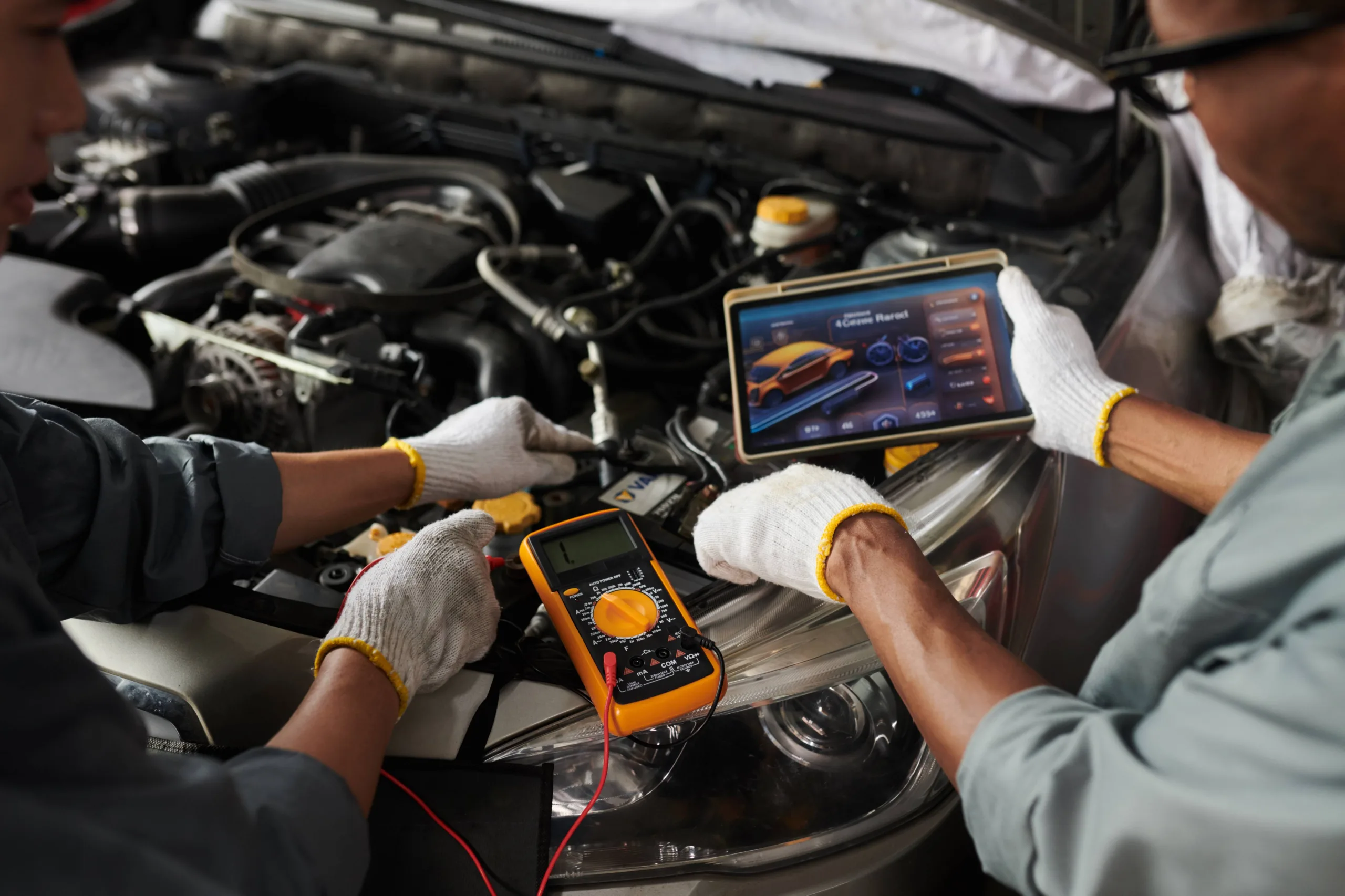
AI in Automotive Diagnostics 2026 marks a structural shift in how modern vehicles are repaired, maintained, and understood. Over the past decade, cars have evolved from mechanical systems with electronic assistance into fully digital machines powered by software-defined architectures.
In 2026, a modern vehicle may generate gigabytes of operational data daily. Electronic Control Units (ECUs), battery management systems, advanced driver assistance systems (ADAS), thermal management modules, and cloud connectivity continuously produce diagnostic information.
The traditional method of reading a fault code and manually interpreting its cause is no longer sufficient. Artificial intelligence is now entering the diagnostic process, offering probabilistic analysis, predictive modeling, and real-time anomaly detection.
This transformation does not eliminate the mechanic. It redefines the role entirely.
AI in Automotive Diagnostics 2026 marks a structural shift in how modern vehicles are repaired, maintained, and understood. Over the past decade, cars have evolved from mechanical systems with electronic assistance into fully digital machines powered by software-defined architectures.
In 2026, a modern vehicle may generate gigabytes of operational data daily. Electronic Control Units (ECUs), battery management systems, advanced driver assistance systems (ADAS), thermal management modules, and cloud connectivity continuously produce diagnostic information.
The traditional method of reading a fault code and manually interpreting its cause is no longer sufficient. Artificial intelligence is now entering the diagnostic process, offering probabilistic analysis, predictive modeling, and real-time anomaly detection.
This transformation does not eliminate the mechanic. It redefines the role entirely.
From OBD Scanners to Intelligent Platforms
Historically, diagnostics relied on OBD-II scanners reading Diagnostic Trouble Codes (DTCs). These codes indicated which system detected irregular behavior, but not necessarily the root cause.
For example:
-
A turbo underboost code may result from a vacuum leak, actuator failure, sensor misreading, or software calibration issue.
-
A battery fault in an EV may relate to cell imbalance, cooling system inefficiency, or BMS miscalculation.
AI in Automotive Diagnostics 2026 introduces multi-layer correlation. Instead of isolating a single error, AI models evaluate:
-
Historical failure patterns
-
Live sensor parameter relationships
-
Temperature fluctuations
-
Voltage behavior under load
-
Driver usage patterns
-
Firmware version compatibility
Machine learning models trained on millions of service cases can suggest the most statistically probable root cause within seconds.
Predictive Maintenance: The 2026 Standard
One of the most transformative aspects of AI in Automotive Diagnostics 2026 is predictive maintenance.
Rather than waiting for a failure to trigger a warning light, AI systems detect deviation trends.
Examples include:
-
Gradual injector efficiency drop
-
Abnormal turbo spool curve
-
Early battery degradation patterns
-
Cooling pump vibration irregularities
-
Sensor calibration drift
By analyzing time-series data, AI identifies anomalies long before traditional threshold-based systems trigger alerts.
Manufacturers such as Tesla already use predictive service models where vehicles schedule service visits autonomously based on internal analytics.
Integration with Electric and Hybrid Vehicles
Electric vehicles amplify the importance of intelligent diagnostics.
High-voltage battery systems involve:
-
Thermal management loops
-
Cell balancing algorithms
-
Power inverter communication
-
Regenerative braking calibration
-
Software-dependent efficiency maps
AI-driven diagnostic tools can analyze complex relationships between energy consumption, driving style, and battery health degradation.
Companies like BMW and Mercedes-Benz have integrated advanced remote diagnostics platforms within their global service networks.
The result: faster turnaround, lower warranty costs, and improved customer retention.
Cloud-Based Diagnostic Ecosystems
Another defining feature of AI in Automotive Diagnostics 2026 is cloud integration.
Modern diagnostic platforms operate within global databases where anonymized vehicle data feeds continuous machine learning improvements.
This enables:
-
Cross-border failure comparison
-
Real-time software patch recommendations
-
Instant recall detection
-
Global trend monitoring
A workshop in Romania can benefit from failure patterns detected in Germany or Japan.
For ongoing technical insights into vehicle electronics and diagnostics, visit:
https://diagnozabam.ro/sfaturi/
The future of repair is no longer local — it is global and data-driven.
Impact on Independent Workshops
AI adoption creates both opportunity and tension.
Opportunities:
-
Faster diagnosis
-
Reduced misdiagnosis
-
Higher repair efficiency
-
Competitive differentiation
Challenges:
-
Restricted manufacturer data access
-
Subscription-based diagnostic platforms
-
Encrypted gateway modules
-
Cybersecurity authentication requirements
The “Right to Repair” debate intensifies in 2026, as independent workshops seek fair access to AI-powered tools and manufacturer databases.
Regulators in Europe are evaluating frameworks to ensure balanced competition.
Cybersecurity and Data Integrity
As diagnostic systems become more intelligent and cloud-connected, cybersecurity becomes essential.
AI diagnostic platforms must include:
-
Encrypted communication
-
Secure authentication tokens
-
ECU-level digital signatures
-
Intrusion detection systems
A compromised diagnostic interface could theoretically manipulate firmware or misinterpret vehicle behavior.
Thus, AI in Automotive Diagnostics 2026 intersects directly with automotive cybersecurity frameworks.
Will AI Replace Mechanics?
The short answer: no.
The more accurate answer: AI replaces guesswork.
In 2026, the modern technician becomes:
-
A data interpreter
-
A system analyst
-
A calibration specialist
-
A software updater
Mechanical intuition remains valuable, but it is enhanced by algorithmic insight.
Workshops increasingly resemble technical laboratories rather than purely mechanical garages.
Economic and Industry Implications
The integration of AI reshapes industry economics:
-
Reduced warranty costs for manufacturers
-
Faster repair cycles
-
Increased demand for software-skilled technicians
-
Subscription-based diagnostic business models
-
Expansion of remote support centers
Training programs must adapt. Future automotive education will require understanding:
-
Data analytics
-
Software architecture
-
Network communication protocols
-
Machine learning basics
The technician of 2030 begins forming in 2026.
The Road Ahead
Looking forward, AI in Automotive Diagnostics 2026 is only the beginning.
Upcoming developments may include:
-
Fully autonomous self-diagnosing vehicles
-
Remote firmware self-repair systems
-
AI-driven calibration adjustments in real time
-
Digital twin modeling of vehicles for predictive simulations
As vehicles become more autonomous, diagnostics will increasingly shift from reactive troubleshooting to continuous digital health monitoring.
Conclusion
AI in Automotive Diagnostics 2026 represents a fundamental shift in automotive repair philosophy. It moves the industry from reactive intervention to predictive intelligence.
The wrench is not disappearing.
But it now works alongside algorithms.
In 2026, the most successful workshops are not just mechanical experts.
They are data-driven problem solvers.
✍️ Author: Bejenaru Alexandru Ionut – [email protected]
🔗 Internal link: https://diagnozabam.ro/sfaturi

