Sodium-ion batteries operate on a principle similar to lithium-ion chemistry. Instead of lithium ions moving between cathode and anode during charge and discharge cycles, sodium ions perform that function.
While the electrochemical structure differs in material composition, the architecture remains conceptually comparable. This allows partial adaptation of existing manufacturing infrastructure.
Key advantages include:
-
Abundant raw material supply
-
Lower theoretical production cost
-
Improved thermal stability
-
Reduced dependency on lithium supply chains
-
Better performance tolerance at low temperatures
Because sodium does not require the same intensive mining and refining complexity as lithium, it offers strategic diversification potential.
Why Sodium-Ion Batteries 2026 Are Gaining Attention
Global EV demand continues to rise. According to market analysts, battery demand is projected to grow exponentially through 2030.
At the same time, lithium prices have experienced volatility over recent years. Supply chain concentration in specific regions has raised geopolitical concerns, especially for Europe and emerging EV markets.
Sodium-Ion Batteries 2026 represent a potential stabilizer.
Major Asian manufacturers such as:
have already announced sodium-ion pilot production and integration plans.
European initiatives are also exploring localized sodium-based battery production to reduce strategic dependency on imported lithium cells.
Performance Compared to Lithium-Ion
The main challenge for Sodium-Ion Batteries 2026 lies in energy density.
Compared to lithium-ion:
-
Lower gravimetric energy density
-
Larger battery size for equivalent capacity
-
Reduced range potential in current generation cells
However, sodium-ion offers advantages in:
This makes sodium-ion particularly attractive for:
For long-range SUVs and premium electric sedans, lithium-ion — and eventually solid-state — still maintain performance superiority.
Industrial Scaling in 2026
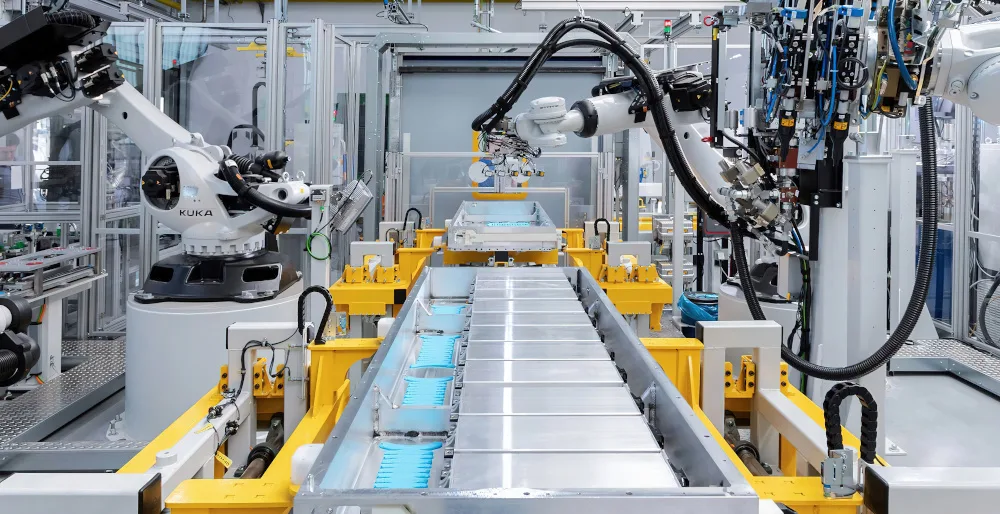
One of the most critical aspects of Sodium-Ion Batteries 2026 is manufacturing scalability.
Unlike experimental chemistries still confined to laboratory prototypes, sodium-ion cells are already entering early-stage industrial production.
The ability to adapt parts of lithium-ion production lines lowers entry barriers.
However, challenges remain:
-
Cathode material optimization
-
Long-term cycle durability validation
-
Supply chain standardization
-
Integration into existing vehicle architectures
Large-scale commercial viability will depend on improving energy density without sacrificing cost advantages.
Impact on the Electric Vehicle Market
If sodium-ion technology scales successfully, several shifts may occur:
-
Lower entry-level EV prices
-
Increased electrification in developing markets
-
Reduced pressure on lithium mining
-
Diversified battery supply chains
Affordable urban EVs powered by sodium-ion could dramatically expand adoption in price-sensitive markets.
For technical analysis of evolving EV technologies and their service implications, visit:
https://diagnozabam.ro/sfaturi/
Battery diversification will also influence diagnostics, repair complexity, and battery management systems in future service environments.
Environmental and Geopolitical Implications
Lithium extraction often involves intensive water usage and complex environmental considerations. Sodium extraction, while not impact-free, generally relies on more abundant and geographically distributed sources.
Sodium-Ion Batteries 2026 therefore represent not only a technological alternative, but a geopolitical one.
Reduced concentration of raw material processing may:
In a world increasingly shaped by resource competition, this factor cannot be ignored.
Limitations and Risks
Despite optimism, sodium-ion technology is not a universal solution.
Key limitations include:
-
Lower maximum range compared to lithium-ion
-
Larger pack volume requirements
-
Long-term degradation data still under validation
-
Market hesitation in early adoption stages
Battery innovation historically follows incremental improvement rather than sudden replacement.
Lithium-ion will not disappear overnight.
The Most Likely Future Scenario
Rather than a total replacement, the realistic 2026–2030 scenario suggests coexistence.
Lithium-ion remains dominant in high-performance and long-range vehicles.
Sodium-ion expands in:
-
Entry-level EVs
-
Fleet vehicles
-
Urban mobility
-
Stationary storage
This multi-chemistry ecosystem may stabilize global battery markets and reduce price volatility.
Conclusion
Sodium-Ion Batteries 2026 do not signal the immediate end of lithium. Instead, they mark the beginning of diversification in battery chemistry.
As electrification accelerates worldwide, relying on a single raw material becomes strategically risky.
Sodium offers abundance.
Lithium offers performance.
The future of electric mobility may not be defined by one winner — but by a balanced coexistence.
The battery race in 2026 is no longer one-dimensional. It is multi-chemical, strategic, and global.