
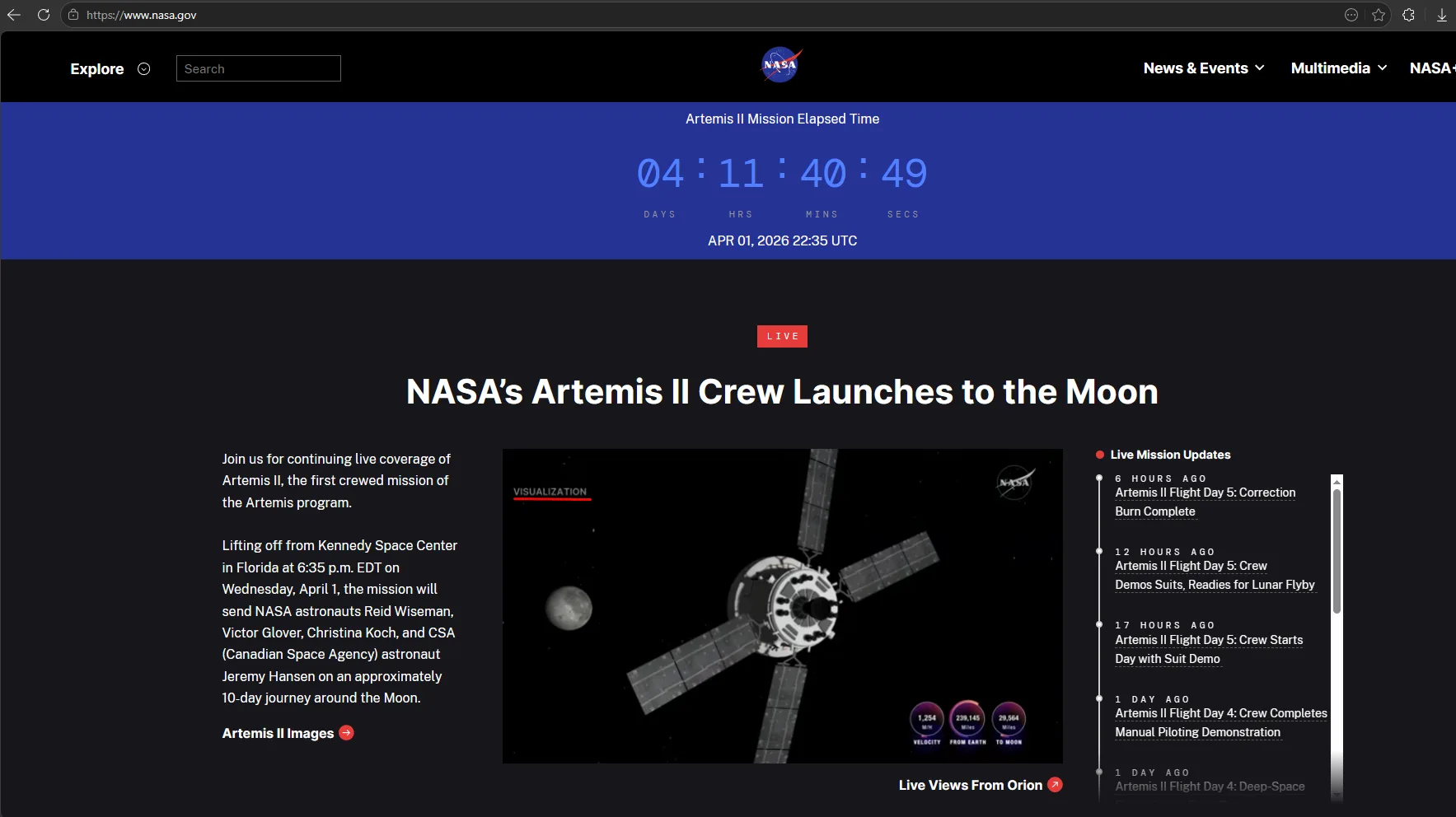
In early April 2026, multiple websites and social media posts claimed that Artemis II had already launched and was orbiting the Moon.
Headlines like “NASA’s Artemis II Crew Launches to the Moon” and “Live from Orion spacecraft” quickly spread online, creating confusion among readers worldwide.
But here’s the reality:
👉 Artemis II has NOT launched.
What actually caused the confusion
The viral misinformation appears to originate from a page on NASA that looked like a real mission dashboard.
However, a key detail was overlooked:
👉 the video content was labeled “VISUALIZATION”
This means:
- CGI simulation
- pre-rendered mission preview
- not real footage from space
Why the “LIVE” stream was misleading
Many users believed they were watching a real-time feed from the Orion spacecraft.
In reality:
- NASA does not provide continuous live video from deep space missions
- communication relies on the Deep Space Network (DSN)
- bandwidth is limited and transmissions are scheduled, not constant
👉 So a “24/7 live stream from the Moon” is technically unrealistic.
The April 1st factor
Another critical detail:
📅 The page displayed the date April 1, 2026
This raises a strong possibility:
- demo content
- pre-launch testing
- or even April Fools-style experimental content
Why so many websites got it wrong
The misinformation spread rapidly due to:
1. Clickbait headlines
Websites prioritize traffic:
- “LIVE from space” gets more clicks
- “Simulation preview” does not
2. Content recycling
Many platforms:
- copied the same story
- translated it
- republished without verification
3. Algorithm amplification
Social media boosted:
- emotional headlines
- “breaking news” style content
👉 accuracy was not prioritized.
What is the real status of Artemis II
As of April 2026:
- Artemis II is still in preparation
- launch expected: late 2026 or 2027
- mission: crewed flyby around the Moon
How to verify space news instantly
Before believing similar claims:
- check official NASA announcements
- verify on major outlets (BBC, Reuters)
- confirm if there is a global live broadcast
👉 If not, it’s likely misinformation.
Conclusion
The viral “Artemis II launch” story is a classic example of how:
- real visuals
- combined with misleading context
- can create believable misinformation
The mission is real.
The images are real (or realistic).
But the launch? Not yet.
✍️ Author: Bejenaru Alexandru Ionut – [email protected]
🔗 Internal link: https://diagnozabam.ro/sfaturi

Recommendation: Looking for a professional bi-directional diagnostic tool with full system coverage? Use code DIAGNOZABAM for 10% off.
Transparency note: Affiliate link. Purchasing through it costs you nothing extra. View Thinkcar Deal →