


The car starter motor is the device responsible for starting the internal combustion engine. Without it, the vehicle won’t start, and failures often cause major stress for drivers. Knowing how it works and what common issues arise can help identify problems early.
How a car starter motor works
The starter converts the battery’s electrical energy into mechanical energy to crank the flywheel. The solenoid pushes the pinion into the flywheel, while current flows through the coil and rotor. Once the engine starts, a one-way clutch prevents the starter from over-spinning.
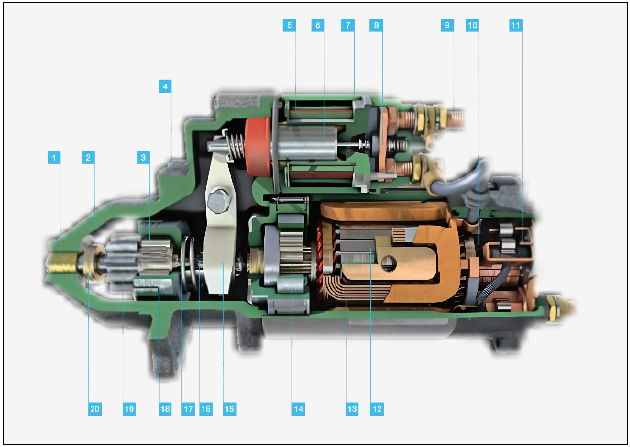
-
Flange – ensures mounting and protection.
-
One-way clutch rolling element – prevents reverse rotation.
-
Mounting flange – secures the starter motor to the engine block.
-
Electromagnetic coil – generates the magnetic field for the plunger.
-
Plunger / Movable core – transmits the mechanical motion.
-
Solenoid – engages the pinion and closes the power circuit.
-
Contact bridge – transfers current from the battery to the motor.
-
Battery terminal T30 – main power supply point.
-
Commutator – transfers current to the rotor.
-
Carbon brush – wear element ensuring contact with the rotor.
-
Armature / Rotor – converts electrical energy into mechanical motion.
-
Field winding / Excitation winding – generates the magnetic field in the stator.
-
Gear reduction – lowers rotation speed while increasing torque.
-
Engagement fork – pushes the pinion into the flywheel.
-
Helical groove – guides the coupling motion.
-
Return spring – brings the pinion back to its initial position.
-
One-way clutch – prevents the starter motor from over-spinning.
-
Pinion – engages the flywheel to start the engine.
-
Retaining ring / Lock – limits the pinion’s travel and keeps it in place.
This carefully engineered structure allows the car starter motor to reliably crank the engine even under harsh conditions, such as low temperatures or reduced battery voltage.
Common failures of the car starter motor
-
Clicking sound but no start – worn carbon brushes or faulty solenoid.
-
Starter spins but engine won’t crank – worn pinion or damaged flywheel teeth.
-
Grinding noises – broken gears in the reducer.
-
Slow cranking – weak battery or corroded contacts.
Solutions and useful tips
-
Regularly check the battery voltage and wiring.
-
Clean corroded terminals.
-
Replace worn brushes in time.
-
Use computer diagnostics in a professional workshop.
👉 Full technical explanation available at AutoTehnica.
👉 More automotive advice on DiagnozaBAM.
✍️ Author: Bejenaru Alexandru Ionut – [email protected]
✍️ Author: Bejenaru Alexandru Ionut – [email protected]
🔗 Internal link: https://diagnozabam.ro/sfaturi

