

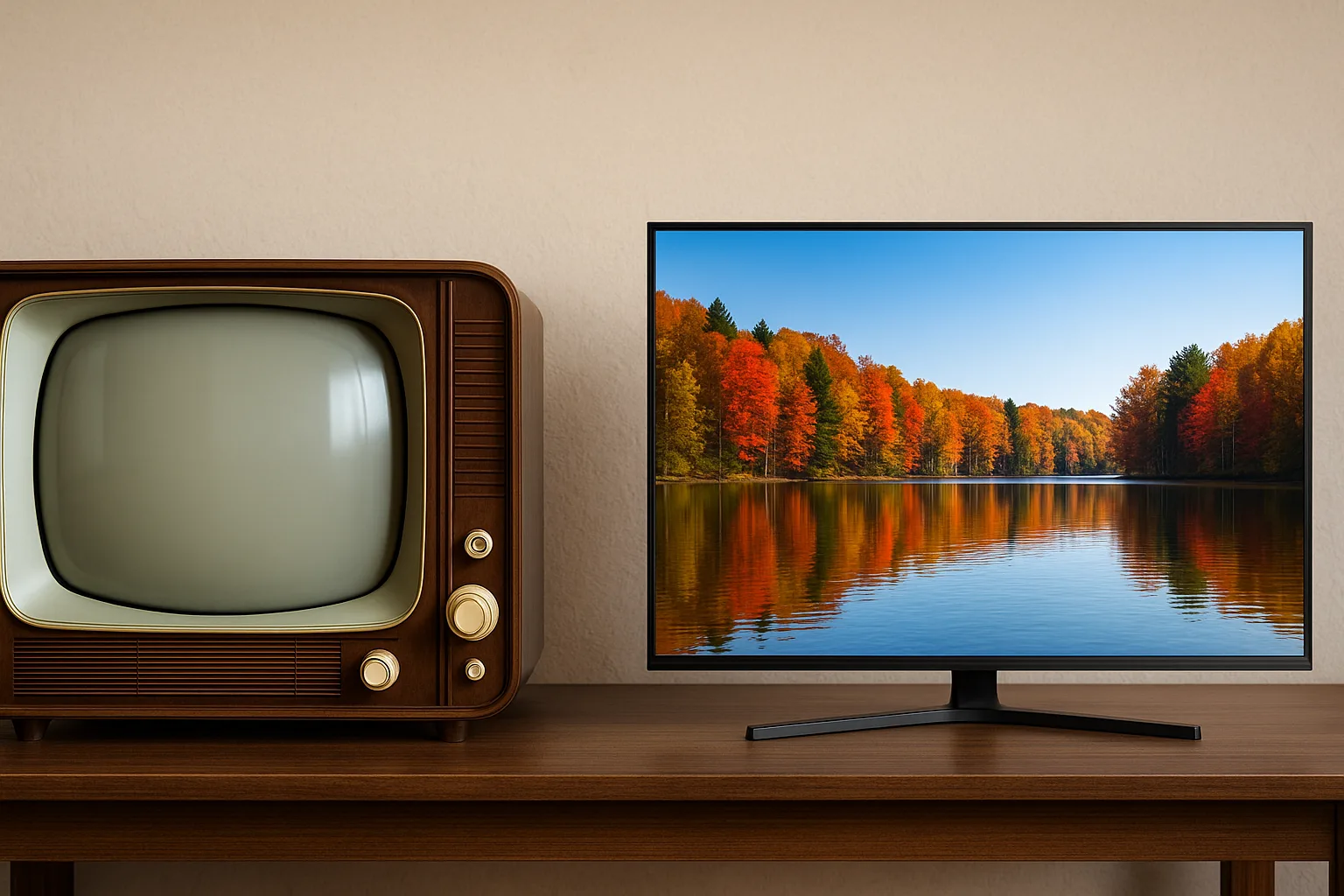
The Invention of Television – From Vision to Reality
The invention of television was not a single event, but a decades-long journey of innovation.
In 1873, Joseph May and Willoughby Smith discovered that selenium changes its conductivity under light exposure — a key breakthrough that opened the path toward image transmission.
Scientists dreamed of sending moving pictures across electrical signals, just as sound was transmitted through telegraphs. That dream soon became reality.
From Mechanical Discs to Moving Images
In 1884, German inventor Paul Nipkow created the Nipkow disc, a rotating mechanism that could scan an image line by line.
Although the images were crude and blurry, Nipkow’s concept marked the birth of mechanical television.
Decades later, Scottish engineer John Logie Baird improved the design and, in 1926, successfully demonstrated the first public TV transmission. By 1928, he achieved the first color and transatlantic broadcast, bringing television into global attention.
Philo Farnsworth and the Electronic Revolution
In 1927, American inventor Philo Farnsworth, at just 21 years old, built the first fully electronic television system.
His invention eliminated all moving parts and replaced them with electronic scanning, making real-time image transmission possible.
Shortly afterward, Vladimir Zworykin developed the iconoscope, and RCA presented the first commercial televisions at the 1939 World’s Fair in New York.
From that moment, television began its unstoppable rise.
The Evolution of Color and Smart Screens
By the 1950s, television entered the color era, turning households into small cinemas.
During the 1970s and 1980s, remote controls and compact designs became the norm.
By the early 2000s, LCD and LED TVs revolutionized picture quality, paving the way for today’s Smart TVs with internet connectivity and ultra-HD resolution.
Impact of the Invention of Television
The invention of television forever changed human communication.
It shaped culture, politics, and education, becoming a mirror of society itself.
Television united billions of people, showing that technology can bridge not only distances but also generations.
Editorial conclusion
Television is more than an invention — it’s a cultural legacy.
While many contributed, Philo Farnsworth remains the central figure who transformed an idea into a global phenomenon.
⚡ From mechanical spinning discs to 8K smart displays, the invention of television continues to evolve — proof that human imagination knows no limits.
✍️ Author: Bejenaru Alexandru Ionut – [email protected]
✍️ Author: Bejenaru Alexandru Ionut – [email protected]
🔗 Internal link: https://diagnozabam.ro/sfaturi

