

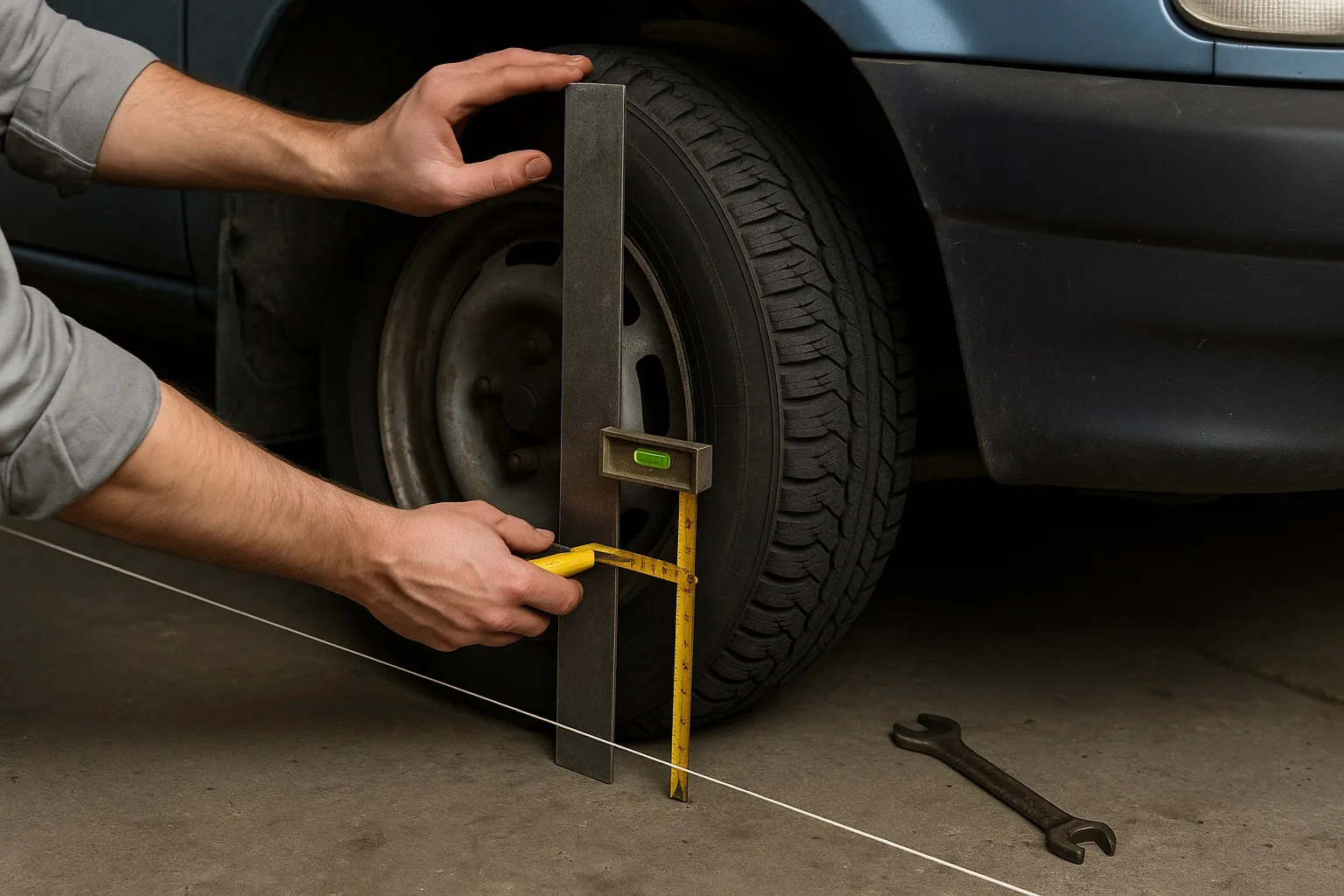
Before 3D alignment systems and laser stands, wheel alignment was done manually, with nothing more than string, rulers, and a trained eye. It was a mechanical skill that required experience, attention to detail, and practical tools.
🔧 What is wheel alignment?
Alignment involves adjusting:
-
Toe (in/out) – how close the front or rear of the wheels are;
-
Camber – how much the wheels tilt inward or outward;
-
Caster – the forward/backward tilt of the steering axis.
📏 Toe adjustment – string and tape measure
Mechanics wrapped a string around the car aligned with the wheels. Using a tape measure, they compared front and rear distances of the wheels to the string:
-
Front closer = toe-in;
-
Rear closer = toe-out.
🛠️ They adjusted the tie rods manually and locked them with counter-nuts.
📐 Camber adjustment – with square and level
A large metal square was placed against the wheel, and a spirit level measured tilt. Adjustments were made by:
-
Adjustable control arms;
-
Eccentric bushings;
-
Or accepted as-is if not adjustable.
🎯 Caster – rarely adjusted manually
Measured with manual angle gauges, caster was only adjusted:
-
On trucks;
-
On modified suspensions;
-
Or after major chassis repairs.
🧰 Old tools used:
| Tool | Purpose |
|---|---|
| Tensioned string | Basic wheel alignment |
| Tape measure / caliper | Measure toe distances |
| Spirit level + square | Measure camber |
| Angle gauge | Measure caster |
| Wrenches | Adjust tie rods |
Conclusion
🔧 In the past, wheel alignment was an art, not a digital process. Mechanics relied on skill and hands-on methods — and they often got it right. Today’s laser alignment makes it faster, but the craftsmanship of manual alignment deserves appreciation.
✍️ Author: Bejenaru Alexandru Ionut – [email protected]
🔗 Internal link: https://diagnozabam.ro/sfaturi

