
How Mechanics Aligned Wheels Before Laser Systems Existed
Long before 3D alignment racks and laser stands took over every shop, wheel alignment was done entirely by hand. No sensors, no screens — just string, a tape measure, a spirit level, and a mechanic who knew exactly what to look for. It was less a procedure and more a mechanical skill, built on experience and a steady eye.
What Wheel Alignment Actually Adjusts
Alignment work centers on three angles, each affecting handling and tire wear differently.
- Toe — how close the front or rear edges of the wheels sit relative to each other
- Camber — how much the wheels tilt inward or outward when viewed from the front
- Caster — the forward or backward tilt of the steering axis
Getting these three right, even without modern equipment, was enough to keep a car tracking straight and wearing its tires evenly.
Toe Adjustment: String and a Tape Measure
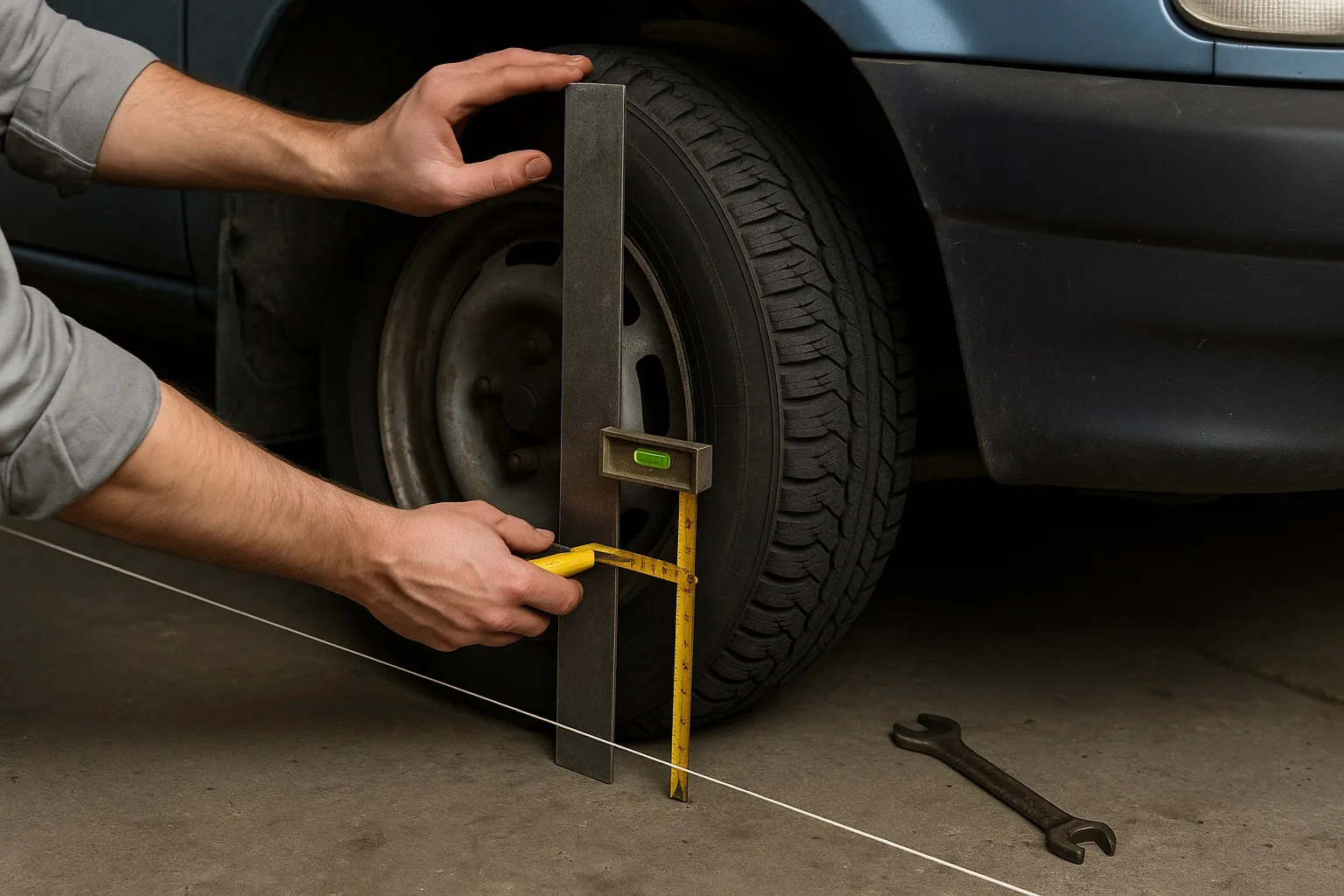
The classic method involved wrapping a string around the car, positioned so it ran parallel to the wheels. With the string set, a mechanic used a tape measure to compare the distance from the string to the front and rear of each wheel.
- If the front measurement came in closer than the rear, that indicated toe-in.
- If the rear measurement was closer, that indicated toe-out.
ℹ️ Technical Note: Toe is measured in fractions of an inch or millimeters, but even small deviations translate directly into uneven tire wear over thousands of kilometers. This is why the string method, crude as it looks, still had to be precise.
Once the reading was taken, adjustment came down to the tie rods. Mechanics turned them manually to shift the angle, then locked everything in place with counter-nuts to prevent the setting from drifting under vibration.
Camber Adjustment: Square and Level
Camber called for a different setup. A large metal square was held flush against the wheel’s face, and a spirit level was used against it to read the tilt angle directly.
Depending on what the vehicle allowed, correcting camber meant one of three things:
- Adjusting the control arms, on vehicles built with that flexibility
- Turning eccentric bushings designed specifically for fine camber correction
- Accepting the factory setting as-is, on vehicles with no adjustment built in
Not every car offered a way to correct camber manually, and mechanics had to know which vehicles allowed it before promising a customer anything.
Caster: The Angle Rarely Touched by Hand
Caster measurement required manual angle gauges, and unlike toe and camber, it wasn’t part of a routine alignment. Adjusting caster by hand was reserved for specific situations:
- Trucks, where steering stability under load made caster more critical
- Vehicles with modified suspensions, where stock geometry no longer applied
- Cars following major chassis repair, where the original angles could no longer be assumed correct
For an average passenger car in for a routine alignment, caster was checked but rarely touched.
The Tools That Made It Possible
| Tool | Purpose |
|---|---|
| Tensioned string | Established a reference line for basic alignment |
| Tape measure / caliper | Measured toe distances against the string |
| Spirit level + square | Measured camber tilt |
| Angle gauge | Measured caster angle |
| Wrenches | Adjusted tie rods and locked settings |
None of these tools were specialized or expensive. What made the process work was the mechanic’s ability to read small measurements accurately and translate them into the correct adjustment, over and over, without electronic feedback confirming each step.
A Skill Worth Remembering
⚠️ Technical Note: Manual alignment methods are far less precise than modern laser or camera-based systems, and attempting them today without proper reference points can result in inaccurate settings and uneven tire wear.
Wheel alignment before digital tools wasn’t a shortcut process — it was a craft built on patience and hands-on measurement. Laser alignment today is faster and considerably more precise, but the manual methods that came before it still deserve credit for getting the job done with nothing more than string, a level, and a trained eye.
✍️ Author: Bejenaru Alexandru Ionut – [email protected]
🔗 Internal link: https://diagnozabam.ro/sfaturi

Recommendation: Looking for a professional bi-directional diagnostic tool with full system coverage? Use code DIAGNOZABAM for 10% off.
Transparency note: Affiliate link. Purchasing through it costs you nothing extra. View Thinkcar Deal →
