
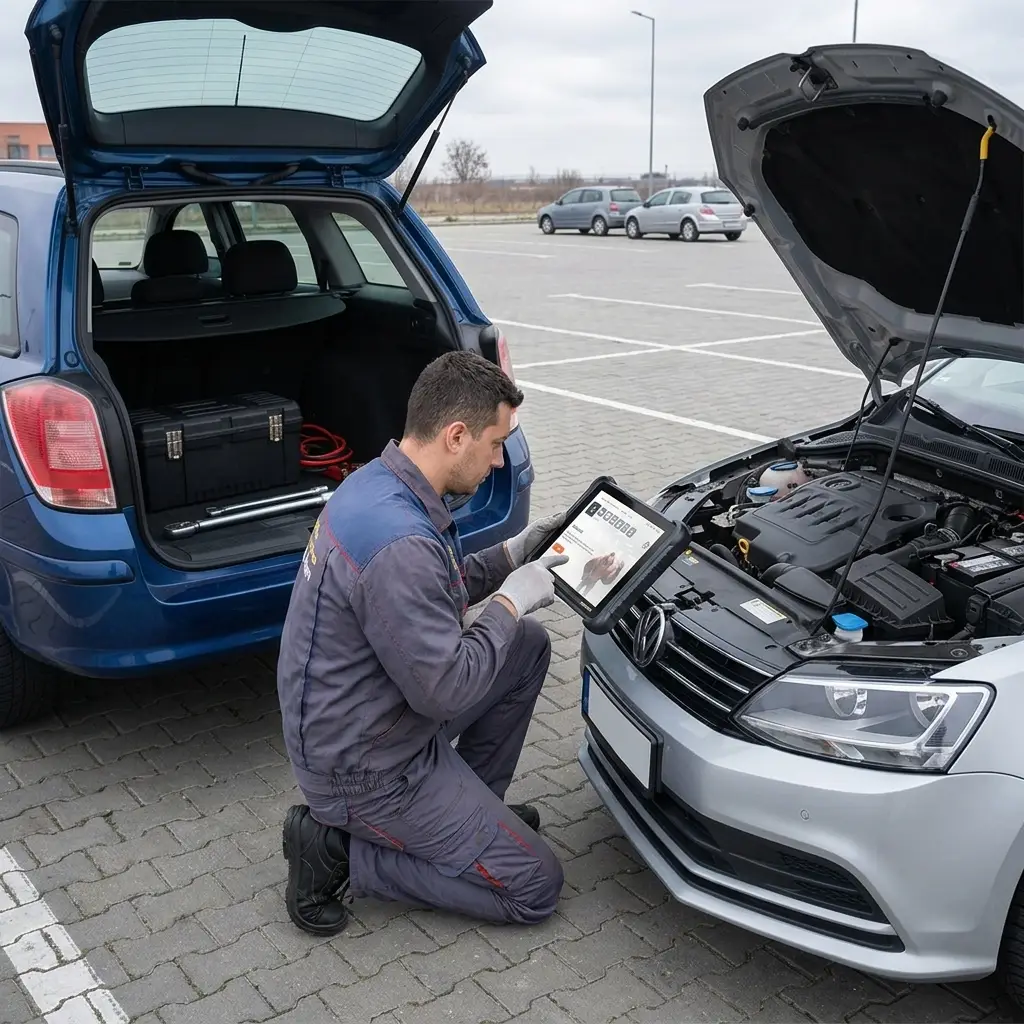
P0171 Toyota: System Too Lean (Bank 1) – Causes, Tests and Fixes
P0171 on a Toyota means the engine computer sees too much air or too little fuel on Bank 1. The mixture is “lean.” The ECU tries to fix it by adding fuel. When it reaches its limit, it sets the code and turns on the check engine light.
The fastest way to find the cause is to read the fuel trims first. Then test in order, from the cheapest check to the most expensive. Most P0171 cases on Toyotas come from a vacuum leak, a dirty MAF sensor or a stuck purge valve. Fuel pump problems are rarer.
What P0171 Actually Means
The ECU wants a precise air-fuel ratio. It measures incoming air with the MAF sensor. It checks the result with the air-fuel ratio sensor in the exhaust.
If the exhaust shows extra oxygen, the mixture is lean. The ECU adds fuel using fuel trim. There are two types:
- Short Term Fuel Trim (STFT): fast, second-by-second corrections.
- Long Term Fuel Trim (LTFT): the learned correction stored over time.
When the combined trim stays far above normal, the ECU gives up and sets P0171. “Bank 1” is the side of the engine that holds cylinder number 1. On a four-cylinder engine, there is only one bank.
ℹ️ Technical Note: Positive fuel trim means the ECU is adding fuel. A value of +20% or more for a long time points to a real lean condition. Healthy engines usually sit within about ±10%.
Common Symptoms
You will usually notice some of these:
- Check engine light on
- Rough or unstable idle
- Hesitation when you accelerate
- Hard starting, especially when cold
- Poor fuel economy
- Occasional stalling at a stop
- A hissing sound from the engine bay
Some cars show no symptoms at all. The light is the only warning.
Most Common Causes on Toyota Engines
Here are the causes in the order I would check them.
| Cause | How common | Typical clue |
|---|---|---|
| Cracked intake air boot | Very common | Trim high at idle, better at higher rpm |
| Vacuum hose or PCV hose leak | Very common | Hissing, rough idle |
| Dirty MAF sensor | Common | Lean at higher load and speed |
| Purge valve stuck open | Common | Rough idle after refueling |
| Exhaust leak before the A/F sensor | Less common | Ticking noise when cold |
| Weak fuel pump or clogged filter | Less common | Lean under heavy load |
| Dirty or weak injectors | Less common | Misfire codes along with P0171 |
| Faulty air-fuel ratio sensor | Rare | Slow sensor response in live data |
1. Intake Air Boot and Vacuum Leaks
Air that enters after the MAF sensor is unmeasured. The ECU does not know about it. The mixture goes lean.
The rubber boot between the MAF sensor and the throttle body cracks with age. The cracks hide in the folds. They open only when the engine moves and the boot flexes.
Also check these parts:
- Brake booster vacuum hose
- PCV valve and PCV hoses
- Intake manifold gaskets
- Small vacuum lines at the back of the engine
- Brittle plastic elbows that crack when touched
2. Dirty or Failing MAF Sensor
A dirty MAF sensor reads less air than actually enters. The ECU injects too little fuel. That creates a lean mixture, usually at higher load.
Clean it only with a spray made for MAF sensors. Never touch the sensing element. Never use brake cleaner or carburetor cleaner.
3. Purge Valve Stuck Open
The purge valve lets fuel vapor from the tank into the intake. If it stays open, extra unmetered air and vapor enter the engine. The idle becomes rough. The effect is strongest at idle.
4. Exhaust Leak
A leak before the air-fuel ratio sensor lets outside air into the exhaust. The sensor reads extra oxygen. It then reports a false lean condition. The engine may actually run fine.
5. Low Fuel Pressure
A weak pump or a clogged filter cannot deliver enough fuel. The engine runs lean when demand is high. Typical moments are hard acceleration and highway climbs.
6. Injectors
Dirty injectors spray less fuel than the ECU expects. This usually appears with misfire codes. One weak injector can push a whole bank lean.
How Air Travels Through the Engine
This simple diagram shows where leaks hurt the most.
Air filter -> MAF sensor -> [intake boot] -> Throttle body -> Intake manifold -> Cylinders
                 |               |                 |                |
            measured air    LEAK HERE         LEAK HERE        LEAK HERE
                           (unmeasured)      (unmeasured)     (unmeasured)
Any leak after the MAF sensor adds air the ECU never counted. That is why a vacuum leak is the first suspect.
Step-by-Step Diagnosis
Follow this order. Do not replace parts until a test points to them.
Step 1: Read the Codes and Freeze Frame
Connect an OBD2 scanner. Write down every code, not only P0171. Then open the freeze frame data. It shows rpm, load and coolant temperature at the moment the code was set.
Check for these related codes:
- P0174: lean on Bank 2, found on V6 engines. If both appear, look for a shared cause such as the MAF sensor, fuel pressure or a main intake leak.
- P0300 to P0304: misfires, often caused by the same lean condition.
- P0441 to P0457: EVAP codes, which point to the purge valve or vapor lines.
Step 2: Check Live Fuel Trims
This test saves the most time. A scanner with live data lets you watch fuel trims in real time. A tool such as the THINKCAR THINKSCAN 689BT can show STFT, LTFT and MAF readings and also run component tests.
Warm the engine fully. Then record the trims at two speeds.
| Observation | Likely cause |
|---|---|
| High trim at idle, drops near 2,500 rpm | Vacuum leak |
| Normal at idle, high at higher rpm and load | MAF sensor or fuel delivery |
| High trim at both idle and 2,500 rpm | Fuel pressure, MAF or exhaust leak |
| Trim jumps after refueling | Purge valve |
ℹ️ Technical Note: A vacuum leak affects idle the most. At higher rpm, the air flowing through the engine is much larger than the leak. The trim falls back toward normal.
Step 3: Visual Inspection
With the engine off, check the following:
- Inspect the intake boot. Bend it gently and look at every fold for cracks.
- Check all clamps. Loose clamps are a common cause.
- Pull on the vacuum hoses. Replace any hose that is soft, swollen or brittle.
- Look at the PCV hose and the dipstick tube seal. A loose dipstick can even set the code.
- Listen with the engine running. A hiss often points straight to the leak.
Step 4: Find the Leak
If the visual check finds nothing, use one of these methods:
- Smoke test: the best method. A smoke machine pushes harmless smoke into the intake. The smoke leaves through any leak. You see it immediately.
- Spray test: spray a small amount of throttle body cleaner near suspected spots with the engine idling. If the idle changes, you found the leak.
⚠️ WARNING: Never spray flammable liquids near hot exhaust parts or ignition components. Use short bursts. Keep a fire extinguisher nearby. A smoke machine is much safer.
Step 5: Test the MAF Sensor
Check the MAF reading at idle in live data. Compare it with the expected value for your engine size. A reading that is too low points to a dirty or failing sensor.
Clean the sensor with a proper MAF spray. Let it dry fully. Then clear the codes and watch the trims again. If the trims return to normal, the sensor was the cause.
Step 6: Test the Purge Valve
Use the scanner’s active test if it supports one. Command the purge valve on and off. Listen for a click.
You can also pinch the vacuum line to the valve at idle. If the idle improves or the trim drops, the valve is leaking. A stuck purge valve often shows up right after you refuel.
Step 7: Check Fuel Pressure
Connect a fuel pressure gauge. Compare the reading with the specification for your exact engine. Test at idle and under load. Pressure that drops when you raise the rpm points to a weak pump or a clogged filter.
Step 8: Inspect the Exhaust
Look for soot trails around the manifold, flex pipe and joints. Listen for ticking when the engine is cold. A leak ahead of the air-fuel ratio sensor can cause a false P0171.
Which Fix Matches Which Result
| Test result | Fix |
|---|---|
| Cracked intake boot | Replace the boot |
| Leaking vacuum or PCV hose | Replace the hose |
| Dirty MAF | Clean, or replace if the readings stay wrong |
| Leaking purge valve | Replace the valve |
| Exhaust leak | Repair the leak or replace the gasket |
| Low fuel pressure | Replace the fuel filter or pump |
| Weak injectors | Clean or replace the injectors |
After the repair, clear the codes. Then drive the car for several days. The ECU needs time to relearn the long term trim. Check the trims again after the drive.
Mistakes to Avoid
- Replacing the oxygen or A/F sensor first. It is rarely the cause. The sensor reports the problem. It does not create it.
- Replacing the MAF without testing. Cleaning it costs very little and often solves the problem.
- Ignoring the code. A long lean condition can overheat the cylinders. It can also damage the catalytic converter.
- Clearing the code and hoping. The code returns until you fix the cause.
- Buying parts from the code description alone. The code tells you the symptom. It does not name the faulty part.
Can You Keep Driving With P0171?
You can drive short distances. Do not ignore the problem for weeks. A lean engine runs hotter. That can burn valves and harm the catalytic converter. Repair is far cheaper than replacing those parts.
If the engine misfires, flashes the light or hesitates badly, stop driving and fix it first.
Quick Checklist
- Read all codes and the freeze frame.
- Check STFT and LTFT at idle and at 2,500 rpm.
- Inspect the intake boot and all hoses.
- Run a smoke test if nothing is visible.
- Clean and test the MAF sensor.
- Test the purge valve.
- Measure the fuel pressure.
- Check the exhaust for leaks before the A/F sensor.
- Clear the codes and drive to relearn the trims.
FAQ
What does P0171 mean on a Toyota?
It means the ECU detected a lean mixture on Bank 1. The engine gets too much air or too little fuel. The ECU has reached its limit for correcting it.
What is the most common cause of P0171 on a Toyota?
A vacuum leak is the most common cause. The cracked intake boot and the PCV hoses are the usual suspects. A dirty MAF sensor comes next.
Can a bad gas cap cause P0171?
A loose gas cap usually sets an EVAP code, not P0171. The purge valve and vapor lines are more likely to cause a lean code.
Can I fix P0171 by cleaning the MAF sensor?
Sometimes. If the MAF is dirty, cleaning it can bring the trims back to normal. Use a MAF-safe spray only. Test the trims afterward to confirm.
Why does P0171 come back after clearing the code?
The cause is still there. Clearing the code only resets the warning. The ECU sets it again as soon as the lean condition returns.
Is P0171 expensive to fix?
It depends on the cause. A cracked hose or a dirty MAF costs little. A fuel pump costs much more. That is why testing before replacing parts matters.
Can P0171 damage the engine?
A long lean condition can overheat the cylinders and damage the catalytic converter. Fix it early to avoid larger repairs.
✍️ Author: Bejenaru Alexandru Ionut – [email protected]

Recommendation: Looking for a professional bi-directional diagnostic tool with full system coverage? Use code DIAGNOZABAM for 10% off.
Transparency note: Affiliate link. Purchasing through it costs you nothing extra. View Thinkcar Deal →