
Hybrid Car: How It Works, Common Problems and Battery Care
A hybrid car combines a petrol engine with an electric motor and a battery. The two work together to cut fuel use. The system is reliable when it is maintained well. The weak points are the high-voltage battery, the cooling of the power electronics and the small 12 V battery.
This guide explains the types of hybrids and how they run. It also covers the faults you will actually meet and the checks that protect the car.
The Types of Hybrid Cars
Not every hybrid works the same way. The type decides the maintenance and the risks.
| Type | Short name | Can it drive on electric only? | Plug-in charging |
|---|---|---|---|
| Mild hybrid | MHEV | No | No |
| Full hybrid | HEV | Yes, for short distances | No |
| Plug-in hybrid | PHEV | Yes, for tens of kilometers | Yes |
- Mild hybrid: a small electric motor assists the engine. It cannot move the car alone.
- Full hybrid: the car can start and drive slowly on electricity. The battery is charged by the engine and by braking.
- Plug-in hybrid: it has a larger battery. You charge it from the grid and it drives longer on electricity.
How a Full Hybrid Works
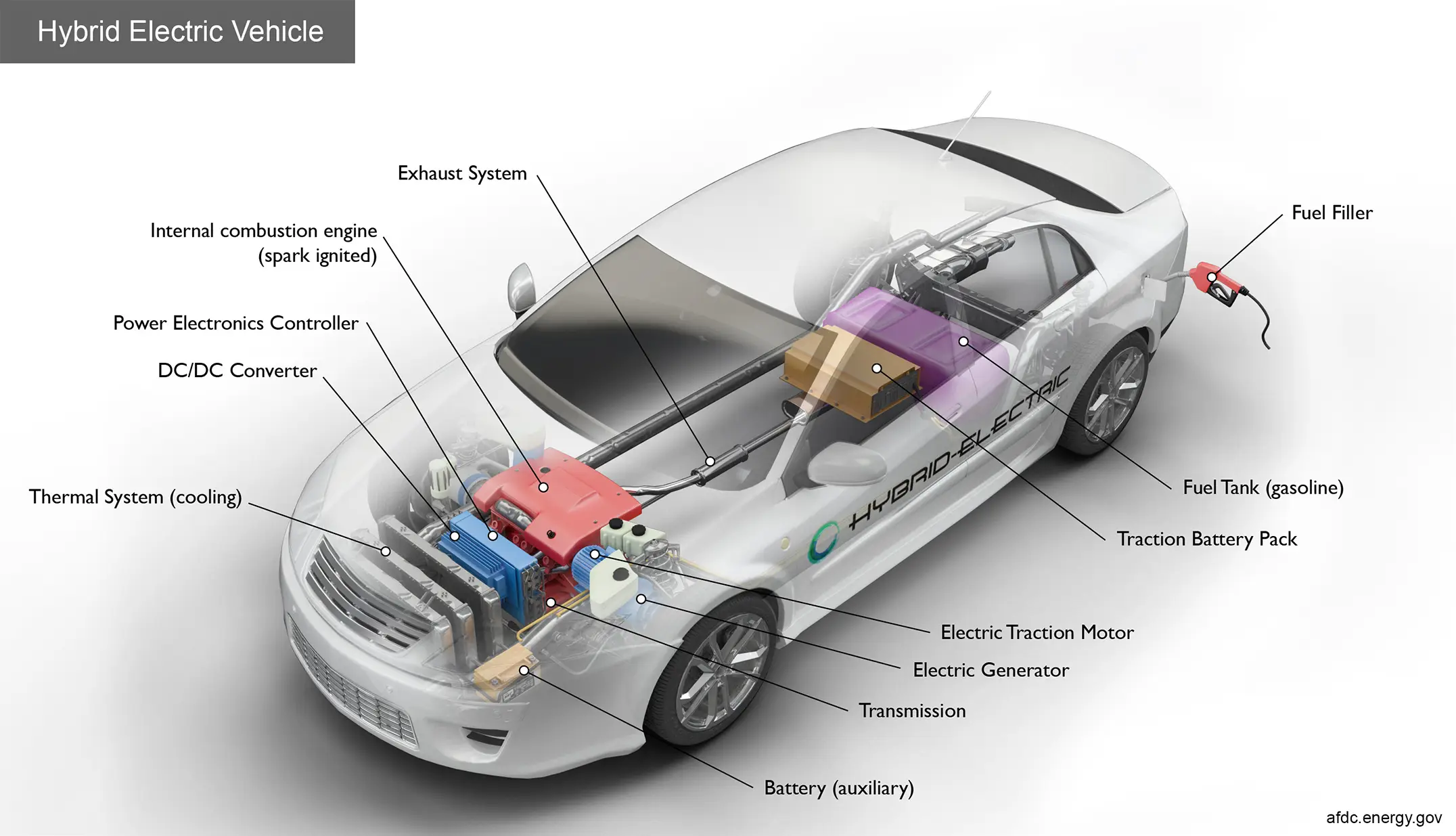
The car has several energy sources and several ways to use them. A control unit decides which one to use at each moment.
Fuel tank -> Petrol engine ----+
                               +--> Power split / transmission --> Wheels
High-voltage battery <--> Inverter <--> Electric motor/generator -+
        ^                                   |
        +------ Regenerative braking -------+
The system works in a few main modes:
- Start and low speed: the electric motor moves the car. The engine stays off.
- Normal driving: the engine and the motor share the work.
- Hard acceleration: both deliver power together.
- Braking and coasting: the motor acts as a generator. It turns movement into electricity and charges the battery.
- Stopped: the engine switches off. The car uses the battery for air conditioning and electronics.
ℹ️ Technical Note: Regenerative braking recovers energy that a normal car loses as heat. That is why a hybrid saves the most fuel in city traffic. It also means the brake pads can last much longer.
The Main Parts You Should Know
High-Voltage Battery
This is the large battery pack that stores the energy for the electric motor. Its voltage is far above the normal 12 V. It is the most expensive part of the system.
Electric Motor and Generator
These move the car and recover energy when you brake. They have few wearing parts. They need clean cooling and sound electrical connections.
Inverter and Converter
The inverter changes the battery’s direct current into alternating current for the motor. The converter lowers the high voltage to 12 V for the normal car systems. These parts produce heat and need cooling.
The 12 V Auxiliary Battery
A hybrid still has a normal small battery. It powers the control units and starts the whole system. A weak 12 V battery can make a healthy hybrid look dead.
Cooling System for the Electronics
Many hybrids have a separate coolant circuit, a pump and sometimes a fan for the battery and the inverter. Blocked air intakes or dirty filters cause overheating.
Common Hybrid Car Problems
1. Weak or Failing 12 V Battery
This is the most common hidden problem. The car shows many warning lights. The system will not start or it shuts down. The high-voltage battery is fine. The small battery is the cause.
Symptoms:
- The car does not “ready” up
- Many unrelated warning lights
- Random electronic faults
- Slow reaction when you press the start button
2. High-Voltage Battery Aging
Like any battery, it loses capacity over time. Heat, deep cycling and age speed this up. You may see less electric driving, more engine running and higher fuel use.
Symptoms:
- The engine starts more often than before
- Fuel economy drops
- The battery charge level swings quickly
- A hybrid system warning light appears
3. Battery Cooling Problems
Some hybrids cool the battery with cabin air. A fan pulls air from a vent, often under the rear seat or in the trunk area. The vent can clog with dust, hair or items stored on the seat. The fan then cannot cool the battery. The battery overheats and the system reduces power.
Symptoms:
- Loud fan noise
- Reduced power
- Battery temperature warnings
4. Inverter or Converter Coolant Issues
Low coolant, a weak pump or air in the circuit can overheat the power electronics. The car may switch to limp mode or show a warning.
5. Brake System Faults
Hybrids use regenerative braking and a hydraulic system together. Pads often last long. But the brakes may corrode from low use. Discs can also rust. A warning light can appear if the brake control system has a fault.
6. Engine Problems on Longer Stops
The engine starts and stops often. Frequent short cycles can strain the starter system or foul the engine with moisture. Regular longer drives help.
7. Software and Sensor Faults
Hybrids rely on many sensors and control modules. A faulty sensor can trigger the hybrid warning light and send the car into protection mode. Many cases are solved with a software update or a sensor replacement.
Warning Lights You Should Not Ignore
- Hybrid system warning: the system found a fault. Do not ignore it.
- Red triangle with other lights: a serious fault is stored. Reduce driving.
- Battery or 12 V charging warning: the auxiliary battery is not charging.
- Check engine light: the petrol engine has a fault. Read the codes.
- Temperature warning: the engine or the electronics are overheating.
⚠️ WARNING: The high-voltage system carries dangerous voltage. Never open orange cables or touch the high-voltage battery. Only trained technicians with the correct tools and training should work on it.
Step-by-Step Checks You Can Do Safely
These checks do not touch the high-voltage system.
Step 1: Check the 12 V Battery
Measure the voltage with a multimeter. A healthy battery at rest shows about 12.6 V. A low reading explains many strange symptoms. Test it first when the car behaves oddly.
Step 2: Check the Battery Cooling Vent
If your car has a cabin air intake for the battery, inspect it. Make sure nothing blocks it. Clean the filter if the model has one. Do not store bags or clothes against the vent.
Step 3: Check the Coolant Levels
Look at the coolant reservoirs. A hybrid can have two circuits. One cools the engine. The other cools the inverter. Use the owner’s manual to find both. Low coolant means a leak.
Step 4: Listen and Feel
Pay attention to unusual fan noise, vibration and sudden engine starts. Note when they happen. This information helps the diagnosis.
Step 5: Read the Codes
A scan tool shows what the system stored. Standard OBD2 tools read engine codes. For hybrid-specific data, you need a tool that can access the hybrid control module. A scanner like the THINKCAR THINKSCAN 689BT can read codes from several modules. On supported models it can show live data such as battery state of charge and battery temperature.
Step 6: Watch the Live Data
If your tool supports it, look at these values:
- State of charge: how full the high-voltage battery is
- Battery temperature: it should stay in a normal range
- Cell or block voltage differences: large gaps point to a weak section
- Inverter temperature
- 12 V system voltage
A large difference between the weakest and strongest battery sections is an early sign of aging.
ℹ️ Technical Note: Hybrid battery packs are made of many cells or modules in series. One weak module can limit the whole pack. This is why some shops can repair a pack by replacing only the weak modules instead of the entire battery.
How to Take Care of a Hybrid Battery
- Drive the car regularly. Long periods of storage can leave the battery at a low charge.
- Avoid constant very low charge. Do not run the system to its lowest level again and again.
- Keep the cooling path clean. A clean vent and filter protect the battery.
- Park in shade in hot climates. Heat ages batteries faster.
- Do not store items on the vent area. Blocked airflow causes overheating.
- Keep the 12 V battery healthy. Replace it when it is weak.
- Follow the service schedule. Coolant and software updates matter.
- Do not ignore warning lights. Small faults grow into larger ones.
If the Car Will Sit for Weeks
Leave the high-voltage battery at a medium charge level if the manual allows. Check the 12 V battery often or use a maintainer. A flat auxiliary battery is the usual reason a stored hybrid will not start.
Hybrid Maintenance: What Changes Compared With a Normal Car
| Item | Hybrid compared with a normal car |
|---|---|
| Brake pads | Often last longer because of regenerative braking |
| Engine oil | Still needed. Use the correct low-viscosity grade |
| Starter and alternator | Replaced by the electric motor and generator in many full hybrids |
| Transmission | Often a special power-split unit with its own fluid |
| Cooling | May include a second circuit for the electronics |
| 12 V battery | Smaller and often a special type. Use the correct replacement |
| Engine wear | Lower in some conditions, but short cycles add stress |
Do not skip the engine oil change because the engine runs less. Oil still ages and absorbs moisture. Change it by the schedule.
Buying a Used Hybrid: What to Check
- Ask for the service history, especially battery and coolant work.
- Check the age and mileage. Older hybrid batteries can show signs of aging.
- Test drive and watch how often the engine starts.
- Compare the fuel economy with the expected value.
- Scan all modules and look for stored hybrid codes.
- Check the battery cooling vent and fan.
- Look for a warning light that appears and disappears.
- Ask whether the battery was replaced or repaired, and by whom.
A hybrid with a documented battery history is a much safer purchase.
Is Hybrid Battery Replacement Always Needed?
No. Many hybrid batteries last for many years and over 200,000 km with correct care. When a pack weakens, you have more than one option:
- Replace the entire pack with a new one. Highest cost, longest peace of mind.
- Use a refurbished pack. Lower cost. The quality depends on the supplier.
- Replace only weak modules. Cheaper, but the new modules must match the old ones.
- Use a used pack from a donor car. The cheapest, but it has an unknown history.
Ask for a diagnostic report before you decide. Compare the cost with the car’s value.
Mistakes to Avoid
- Ignoring the 12 V battery. It causes many “mystery” faults.
- Blocking the battery vent. It leads to overheating.
- Touching orange high-voltage cables. It is dangerous.
- Assuming a hybrid needs no maintenance. It needs regular service.
- Buying a used hybrid without scanning it. Hidden faults can be expensive.
- Using the wrong coolant or oil. Hybrids can need special fluids.
- Leaving the car unused for months. Both batteries suffer.
- Replacing the high-voltage battery without a proper test. The fault may be elsewhere.
Quick Checklist
- Identify whether the car is a mild hybrid, full hybrid or plug-in hybrid.
- Test the 12 V battery first when you see odd faults.
- Keep the battery cooling vent clean and open.
- Check both coolant circuits.
- Read codes from the hybrid module, not only the engine.
- Watch the battery state of charge, temperature and module balance.
- Follow the service schedule and use the correct fluids.
- Never touch orange high-voltage cables.
- Drive the car regularly.
- Get a diagnostic report before you buy a used hybrid or replace a battery.
FAQ
How does a hybrid car work?
It uses a petrol engine and an electric motor together. A computer decides which one to use. The battery recovers energy when you brake, so the car uses less fuel.
What is the most common problem with hybrid cars?
The small 12 V battery is a common hidden cause. It can trigger many warning lights and prevent the system from starting. After that come battery cooling problems and aging of the high-voltage battery.
How long does a hybrid battery last?
Many last for many years and well over 200,000 km. Heat, age and poor cooling shorten that life. Clean cooling and regular driving help.
Are hybrid cars expensive to maintain?
Routine service costs are often similar to a normal car. Brakes can last longer. A major battery repair is the expensive risk, so a good history matters.
Can I jump-start a hybrid car?
Often yes, but only through the 12 V jump points that the manual shows. Never connect to the high-voltage system. Follow the manual exactly.
Do hybrid cars need oil changes?
Yes. The petrol engine still uses oil. The oil ages and collects moisture even if the engine runs less. Follow the service schedule.
Is it safe to work on a hybrid car?
Basic tasks like checking fluids and the 12 V battery are safe. The high-voltage system is dangerous. Leave it to trained technicians.
✍️ Author: Bejenaru Alexandru Ionut – [email protected]

Recommendation: Looking for a professional bi-directional diagnostic tool with full system coverage? Use code DIAGNOZABAM for 10% off.
Transparency note: Affiliate link. Purchasing through it costs you nothing extra. View Thinkcar Deal →