
How to Maintain a Car Battery: Habits and Checks That Add Years of Life
A car battery dies from bad habits far more often than from age. Short trips, long idling and unnecessary electrical consumers drain it slowly. The alternator cannot refill it fast enough. The fix is simple. Drive the car with the engine turning above idle, switch off what you do not need, and test the battery twice a year.
This guide uses a common example: the Opel Astra H 1.9 CDTI (Z19DT) from 2007. It is a diesel with high cranking demand. It shows very clearly what happens when the battery is not kept in good condition.
How the Battery and Charging System Work
The battery does one big job. It starts the engine. After that, the alternator powers the car and recharges the battery.
Battery -> Starter motor -> Engine runs -> Alternator -> Powers consumers + recharges batteryThe alternator is driven by a belt. Its output depends on engine speed. At idle, the alternator spins slowly and produces little current. At higher rpm, it produces much more.
ℹ️ Technical Note: A healthy battery at rest shows about 12.6 V. With the engine running, the charging voltage is usually between 13.8 V and 14.7 V. A reading outside that range points to a charging fault.
Why Idling Is Bad for the Battery
Many drivers think idling charges the battery. It does, but very little. At idle, the alternator barely covers the car’s own needs. The battery gets almost nothing.
Now add consumers. The heated rear window, the blower fan, the headlights and the radio all pull current. At idle, their demand can be higher than what the alternator makes. The battery then supplies the difference. It discharges while the engine is running.
This is the trap. The engine is on, but the battery is draining.
The Short Trip Problem
Starting the engine takes a large amount of energy. A diesel needs even more, especially in cold weather. The battery must get that energy back.
A trip of five minutes does not do it. The battery leaves home a little less charged each time. After a few weeks, it is weak. After a few months, it is damaged.
Rule 1: Drive With the Engine Turning Above Idle
This is the most useful habit. Let the engine work in a range where the alternator can actually charge.
- Drive, do not idle. A 30-minute drive charges far better than 30 minutes of idling.
- Keep the revs up a little. Driving in a reasonable gear at about 1,500 to 2,500 rpm gives the alternator more output than crawling at idle.
- Avoid lugging. Do not use a very high gear at very low rpm. It stresses the engine and does not help the battery.
- Do not rev the engine in neutral for minutes. It wastes fuel and wears the engine. A proper drive is better.
On a diesel like the Z19DT, idle speed is low. The alternator turns slowly. In winter traffic, with the fan, the rear window heating and the lights on, the battery can lose charge even while you drive in the city.
A longer drive on a road where you can keep a steady speed solves this. It is the cheapest “charger” you have.
Rule 2: Do Not Use Consumers You Do Not Need
Every electrical item takes current from the same source. Switch off what is not useful, especially when the engine is at idle or when you start it.
| Consumer | Approximate effect | When to switch it off |
|---|---|---|
| Heated rear window | High | As soon as the glass is clear |
| Heated seats | High | After the seat is warm |
| Blower fan at maximum | Medium to high | Lower the speed when possible |
| Headlights and fog lights | Medium | Fog lights only when needed |
| Radio and amplifier | Low to medium | Off when parked with the engine running |
| Phone chargers, dash cameras, extra devices | Low, but constant | Unplug when not needed |
| Aftermarket accessories | Varies | Check for parasitic drain |
Before You Start the Engine
- Switch off the lights, the fan, the radio and the heated rear window.
- On a diesel, wait for the glow plug light to go out.
- Do not hold the key in the start position for long. Short attempts protect the battery.
Starting with many consumers on forces the battery to give more current at the worst moment. That is how a weak battery fails on a cold morning.
While Parked With the Engine Off
Never listen to the radio or use the interior lights for a long time with the engine off. Even a short session can drain an older battery. Diesel engines need a strong battery in the morning.
Example: Astra H 1.9 CDTI Z19DT (2007)
The Astra H is an old car now. Many still run on their first or second battery. Here is what matters on this model.
- Diesel cranking load. The Z19DT needs a strong, healthy battery in cold weather. A battery that works in summer can fail in the first frost.
- Electronics are sensitive to low voltage. A weak battery can cause random warnings, slow window operation and odd behavior from the control modules. Many people chase electrical ghosts when the battery is the problem.
- Many consumers on short trips. A typical city use pattern is short drives, fan on, rear window on, lights on. That is exactly the situation that drains the battery.
- Age of the car. At this age, the alternator and its wiring also deserve a check. A weak alternator kills a good battery.
The practical advice for this car is simple. Test the battery before every winter. Test the charging voltage once a year. Take a longer drive every week if the car is used mostly in the city.
Other Habits That Protect the Battery
Keep the Terminals Clean
White or green corrosion on the terminals creates resistance. The result is hard starting and poor charging.
- Switch off the engine and the ignition.
- Disconnect the negative terminal first, then the positive.
- Clean the terminals and posts with a brush and a baking soda and water mix.
- Dry everything and reconnect the positive first, then the negative.
- Add a thin coat of terminal grease.
⚠️ WARNING: Wear gloves and eye protection when you work on a battery. Never smoke or use open flame nearby. A battery can release explosive gas. Keep metal tools away from both terminals at the same time.
Make Sure the Battery Is Fixed Firmly
A loose battery vibrates. Vibration damages the plates inside. Check the clamp and the holder. The battery must not move.
Check for Parasitic Drain
If the battery goes flat after a few days of parking, something draws current when the car is off. Common causes are a faulty relay, a trunk light that stays on, a bad aftermarket alarm or a radio that does not sleep.
A multimeter in series with the battery cable shows the drain. A healthy modern car should settle at a very low current after the modules go to sleep. A high reading means you must find the circuit that causes it.
Use a Smart Charger When Needed
If the car sits for weeks, connect a proper smart charger or maintainer. Do not use an old, uncontrolled charger. It can overcharge and damage the battery.
Protect It From Extreme Temperatures
Heat ages batteries faster. Cold exposes weakness. In very hot weather, park in shade when you can. In winter, a weak battery gets worse each frosty night.
How to Test the Battery
Step 1: Visual Check
Look for a swollen case, leaks, cracks and corrosion. A swollen battery must be replaced at once.
Step 2: Rest Voltage
Let the car stand for a few hours with everything off. Measure the voltage at the terminals.
| Voltage at rest | Meaning |
|---|---|
| 12.6 V or more | Fully charged |
| About 12.4 V | Around 75% charge |
| About 12.2 V | Around 50% charge |
| Below 12.0 V | Discharged, needs charging and a proper test |
Step 3: Cranking Voltage
Watch the voltage while a helper starts the engine. It should stay above about 9.6 V during cranking. If it falls much lower, the battery is weak or the connections are bad.
Step 4: Charging Voltage
Start the engine and measure again. You should see around 13.8 V to 14.7 V. Then switch on the heated rear window, the lights and the fan. The voltage must stay stable.
- Below 13.5 V: possible alternator, belt or wiring problem.
- Above 15 V: possible regulator fault. This can boil the battery.
A diagnostic scanner can help here. A tool like the THINKCAR THINKSCAN 689BT shows the system voltage in live data. You can watch it change at idle, under load and at higher rpm. It also reads stored electrical codes.
Step 5: Load Test
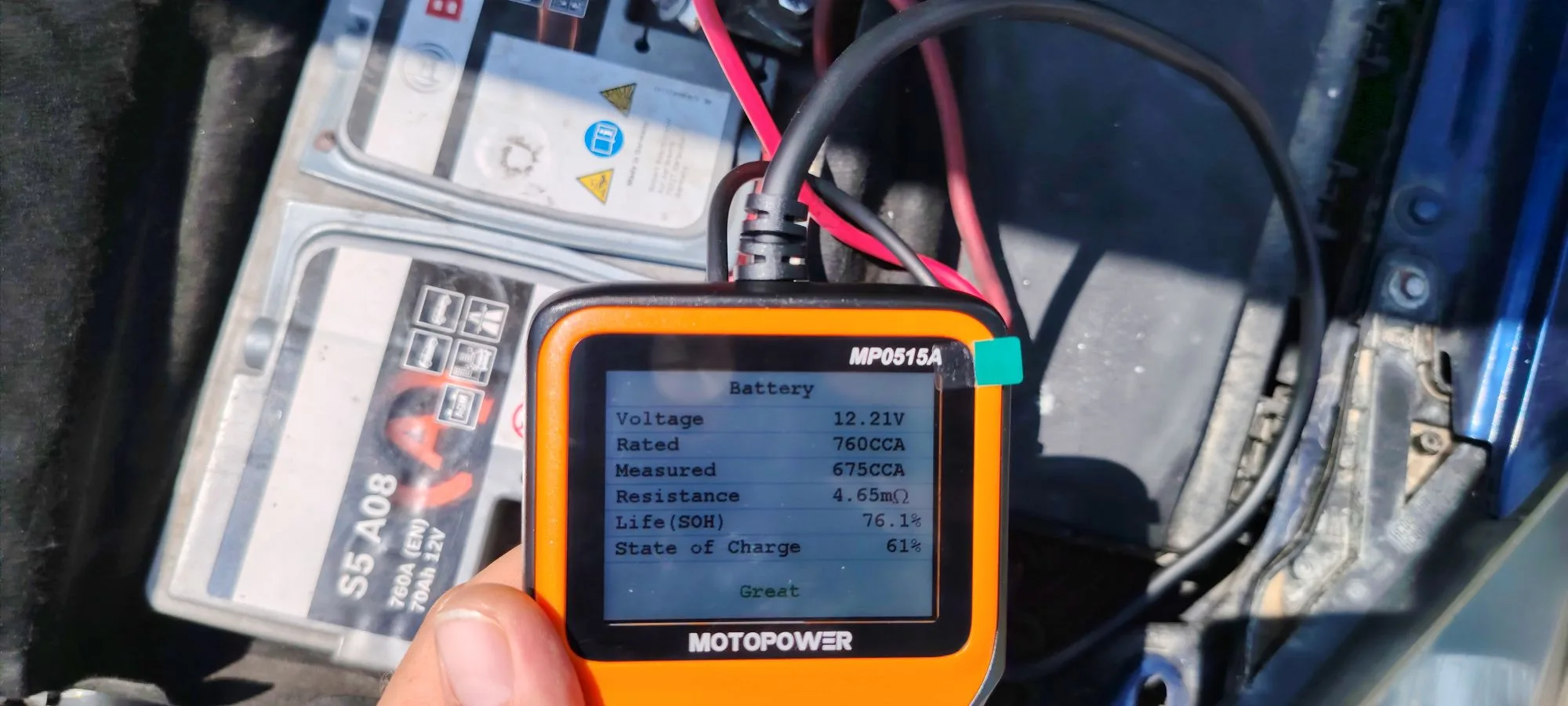
A voltage reading does not show the real health of the battery. A proper battery tester applies a load or measures internal resistance. It reports capacity and health. This is the only test that really tells you if the battery can still start the engine in the cold.
Signs That the Battery Is Failing
- Slow cranking, especially when cold
- Clicking sound when you turn the key
- Dim headlights at idle
- Warning lights that flicker at start
- Electronics that reset
- A battery light on the dashboard
- Swollen case or a rotten egg smell
- The battery is more than four or five years old
Replace the battery before it leaves you stranded. A planned replacement is cheaper than a tow.
Mistakes That Kill Batteries
- Letting the car idle for long periods. It does not charge properly.
- Only short trips. The battery never recovers.
- Running many consumers at idle. The battery supplies the deficit.
- Ignoring slow cranking. It is an early warning.
- Leaving the battery discharged. Deep discharge damages the plates.
- Using a cheap, uncontrolled charger. It can overcharge.
- Replacing only the battery when the alternator is bad. The new one dies soon too.
- Loose terminals and corrosion. They cause poor charging and starting.
Quick Maintenance Checklist
- Take a longer drive every week, and do not rely on idling.
- Keep the engine above idle speed when you need charging.
- Switch off consumers you do not need.
- Switch off all consumers before starting the engine.
- Clean the terminals twice a year.
- Check that the battery is fixed firmly.
- Measure the rest voltage once a month in winter.
- Check the charging voltage once a year.
- Do a load test before winter.
- Replace the battery at the first clear sign of weakness.
FAQ
How often should I maintain a car battery?
Check it at least twice a year, before summer and before winter. Do a visual check and a voltage test. Add a load test once a year if the battery is older than three years.
Does idling charge a car battery?
Only a little. At idle, the alternator produces low output. With consumers on, the battery can even discharge. Driving at higher engine speed charges much better.
How long should I drive to charge the battery?
A drive of 30 minutes or more at normal speed is a good starting point. Short trips of a few minutes do not replace the energy used to start the engine.
Which consumers drain the battery the most?
The heated rear window, heated seats, the blower fan on high and the headlights draw the most current. Switch them off when you do not need them, especially at idle.
How long does a car battery last?
Most last between three and six years. Heat, short trips, deep discharge and weak charging shorten that life. Good habits can extend it.
Can a weak battery cause strange electrical problems?
Yes. Low voltage can cause warnings, slow windows, resetting electronics and starting problems. Test the battery and the charging system before you replace expensive parts.
Is it better to disconnect the battery when I do not drive?
For long storage, a smart maintainer is better. It keeps the battery charged. Disconnecting can reset the car’s memory and does not stop self-discharge.
✍️ Author: Bejenaru Alexandru Ionut – [email protected]

Recommendation: Looking for a professional bi-directional diagnostic tool with full system coverage? Use code DIAGNOZABAM for 10% off.
Transparency note: Affiliate link. Purchasing through it costs you nothing extra. View Thinkcar Deal →