
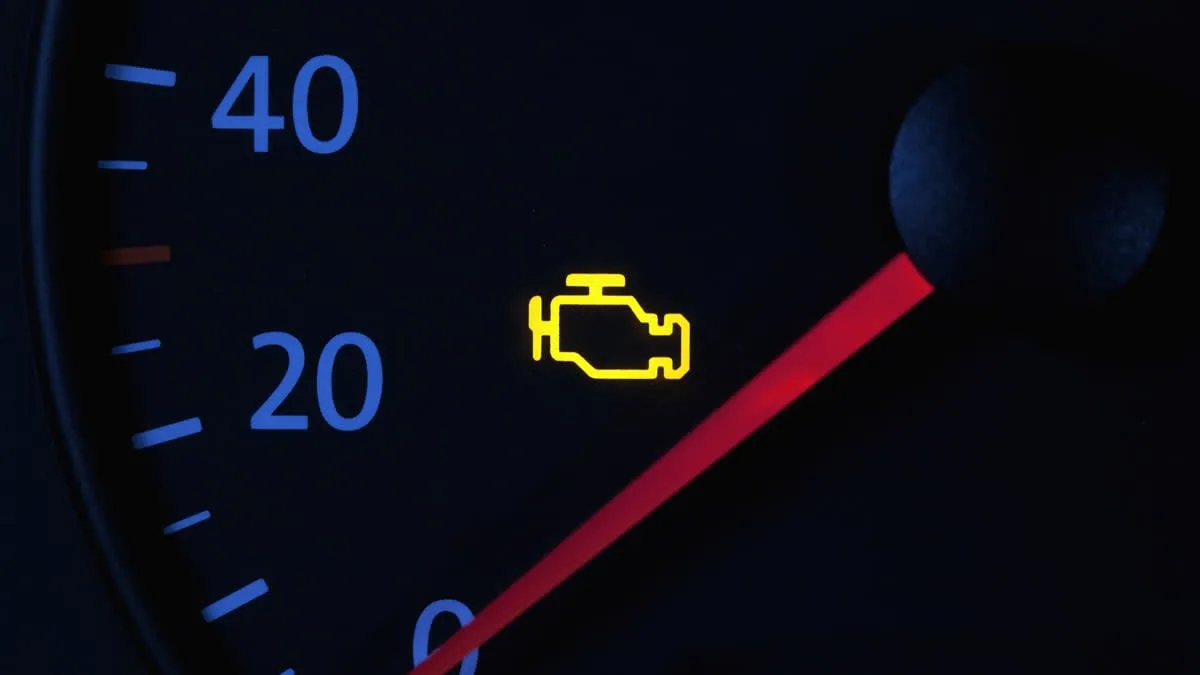
Check Engine Light: What to Check First (Steady vs Flashing)
A check engine light means the ECU found a fault it cannot fix on its own. The fault can be minor, like a loose gas cap. It can also be serious, like an active misfire. The first thing to look at is how the light behaves.
A steady light means “get it checked soon.” A flashing light means “reduce load now.” Everything else follows from those two states. Then you read the code, check the basics and decide whether to drive on.
Step 0: Steady or Flashing?
This decides how fast you must act.
| Light behavior | What it means | What to do |
|---|---|---|
| Steady, car drives normally | A fault was stored. Often emissions related | Check the basics, read the code within days |
| Steady, car runs rough or loses power | A real fault is affecting performance | Reduce speed, diagnose soon |
| Flashing | Active misfire that can damage the catalytic converter | Reduce load, stop driving as soon as it is safe |
| Light plus red oil or temperature warning | Possible engine damage risk | Stop and switch off the engine |
⚠️ WARNING: A flashing check engine light means raw fuel may be reaching the exhaust. That can overheat and destroy the catalytic converter within minutes. Do not accelerate hard or tow with a flashing light.
The 60-Second Roadside Checks
Do these first. They cost nothing. They solve more cases than most people expect.
- Check the gas cap. Remove it and refit it until it clicks. A loose or cracked cap can set an EVAP code.
- Look at the dashboard. Note any other warning lights. Oil, battery and temperature lights change the urgency.
- Check the temperature gauge. An overheating engine needs a stop, not a scanner.
- Listen to the engine. Note any knocking, ticking, hissing or rattling.
- Feel the drive. Note hesitation, rough idle, lost power or strange gear shifts.
- Think about the last refuel. Bad fuel or a cap left loose can trigger the light right after a fill-up.
Write down what you noticed. This helps the diagnosis later.
Step 1: Read the Code
The light tells you something is wrong. The code tells you where to look. You need an OBD2 scanner for this. Every car sold in Europe since 2001 (petrol) and 2004 (diesel) has the standard OBD2 port.
The port sits under the dashboard, usually near the driver’s knees. Plug in the scanner. Turn the ignition on. Read all stored codes, not only the first one.
A scanner like the THINKCAR THINKSCAN 689BT reads codes over Bluetooth. It also shows live data and freeze frame, which matter a lot in the next steps.
How to Read an OBD2 Code
Every code has five characters. Here is what each part means.
P 0 1 7 1
| | | | |
| | | +-+-- specific fault number
| | +------ subsystem (1 = fuel and air metering)
| +-------- 0 = generic code, 1 = manufacturer specific
+---------- P = Powertrain, B = Body, C = Chassis, U = Network
The subsystem digit is a useful shortcut:
- P01xx: fuel and air metering
- P02xx: injector circuits
- P03xx: ignition and misfires
- P04xx: emission controls
- P05xx: idle and speed control
- P06xx: computer and outputs
- P07xx and P08xx: transmission
ℹ️ Technical Note: A code names the circuit or the condition. It does not name the faulty part. A lean code does not mean “replace the oxygen sensor.” Test first, then replace.
Step 2: Check Freeze Frame
Freeze frame is a snapshot. The ECU saves it at the moment the fault was set. It records:
- Engine speed
- Engine load
- Coolant temperature
- Vehicle speed
- Fuel trim values
Use it to recreate the conditions. A fault that appears only on a cold start needs a different test than a fault at highway speed.
The Most Common Causes of a Check Engine Light
These are the usual suspects, from simple to complex.
| Cause | Typical codes | Typical clue |
|---|---|---|
| Loose or faulty gas cap | P0455, P0457 | Light after refueling |
| Oxygen or A/F sensor fault | P0130 to P0167 | Poor fuel economy |
| Worn spark plugs or ignition coils | P0300 to P0304 | Misfire, rough idle |
| Mass airflow sensor problem | P0101, P0102 | Hesitation, stalling |
| Vacuum leak | P0171, P0174 | Rough idle, hissing |
| Catalytic converter efficiency | P0420, P0430 | Often after another fault |
| EGR valve fault | P0401, P0402 | Rough idle, loss of power |
| Diesel particulate filter issue | P2002, P244x | Regeneration problems |
| Battery or charging fault | P0562, P0563 | Weak battery, electrical glitches |
| Thermostat stuck open | P0128 | Engine slow to warm up |
Step 3: Match the Symptom to the Likely Cause
Codes help, but symptoms narrow the search.
Rough Idle or Shaking
Think of misfires first. Check the spark plugs and ignition coils on petrol engines. On diesels, think of injectors and glow plugs. Also check for vacuum leaks.
Loss of Power
Check the air filter, the MAF sensor and the turbo hoses. On a diesel, a clogged DPF or EGR valve can also reduce power. The car may enter limp mode.
Poor Fuel Economy
Look at oxygen sensors, the thermostat and the MAF sensor. A thermostat stuck open keeps the engine too cool. The ECU then runs a richer mixture.
Hard Starting
Check the battery and its voltage. Then look at fuel delivery and the crankshaft sensor. A weak battery can set several unrelated codes.
Light On Only After a Cold Start
Think of the thermostat, glow plugs on a diesel, or a sensor with a heating fault.
ℹ️ Technical Note: A weak battery causes strange faults. Low voltage can make sensors report wrong values. Always test the battery and charging system before chasing multiple unrelated codes.
Step 4: Use Live Data
Live data shows what the engine does right now. This is where real diagnosis starts. Watch these values:
- Coolant temperature: it should rise to about 90°C and stay stable.
- Short and long term fuel trim: values far from zero point to air or fuel problems.
- MAF reading: it should rise smoothly with rpm.
- O2 or A/F sensor: the signal should react quickly.
- Battery voltage: about 14 V with the engine running.
- Misfire counters: these show which cylinder is the problem.
Compare the readings with a known good value. A sensor that reads out of range is often the real clue.
Step 5: Decide: Drive, Slow Down or Stop
Use this simple guide.
| Situation | Decision |
|---|---|
| Steady light, normal driving | Drive carefully, diagnose within a few days |
| Steady light, rough running | Drive gently to a safe place, diagnose soon |
| Flashing light | Stop driving or drive very gently to the nearest stop |
| Light plus overheating | Stop at once and shut off the engine |
| Light plus low oil pressure | Stop at once and shut off the engine |
| Light plus limp mode | Drive slowly, get it checked immediately |
What Not to Do
- Do not clear the code and forget it. The cause is still there.
- Do not disconnect the battery to “reset” the light. It erases useful data and the fault returns.
- Do not replace parts by guessing. Test first.
- Do not ignore a steady light for months. Small faults grow into expensive ones.
- Do not use a “check engine light eliminator” device. It hides the warning and not the problem.
- Do not drive hard with a flashing light. That is how catalytic converters die.
Will the Light Go Off by Itself?
Sometimes. If the cause was temporary, the ECU may turn the light off after several clean drive cycles. A loose gas cap is a typical example.
The stored code can stay in memory longer. A mechanic or scanner can still see it. If the light returns, the fault is real and needs attention.
Will a Check Engine Light Fail the Inspection?
In most countries, an active check engine light is a reason to fail an emissions test or technical inspection. Fix the cause first. Then drive normally for a few days so the monitors can complete. Clearing the code right before the test is a bad idea. The system shows “not ready” and the inspector can see that.
Quick Checklist
- Is the light steady or flashing?
- Check the gas cap.
- Check other warning lights and the temperature gauge.
- Plug in an OBD2 scanner and read all codes.
- Open freeze frame data.
- Look at live data for the suspect system.
- Match the symptoms with the likely cause.
- Test before you replace anything.
- Clear the code only after the repair.
- Drive a few days and confirm the light stays off.
FAQ
What does a check engine light mean?
It means the ECU found a fault in the engine, emissions or related systems. The fault can be minor or serious. You need to read the code to know which.
Can I drive with the check engine light on?
Yes, if the light is steady and the car runs normally. Get it checked soon. Do not drive if the light flashes, the engine overheats or the oil warning lights up.
What is the most common reason for a check engine light?
A loose gas cap, a faulty oxygen sensor and worn spark plugs are the most common reasons. A vacuum leak and a failing MAF sensor also appear often.
Why is my check engine light flashing?
A flashing light usually means an active misfire. Unburned fuel can reach the catalytic converter and damage it. Reduce load and stop driving as soon as it is safe.
Can a weak battery turn on the check engine light?
Yes. Low voltage can confuse sensors and the ECU. Test the battery and the alternator before you chase several unrelated codes.
How do I turn off the check engine light?
Fix the cause first. Then clear the code with a scanner. The light also goes off after several clean drive cycles. If the cause remains, the light comes back.
Do I need an expensive scanner?
No. A basic OBD2 scanner reads and clears codes. A better one shows live data, freeze frame and component tests. That saves time when you want to find the real cause.
✍️ Author: Bejenaru Alexandru Ionut – [email protected]

Recommendation: Looking for a professional bi-directional diagnostic tool with full system coverage? Use code DIAGNOZABAM for 10% off.
Transparency note: Affiliate link. Purchasing through it costs you nothing extra. View Thinkcar Deal →