

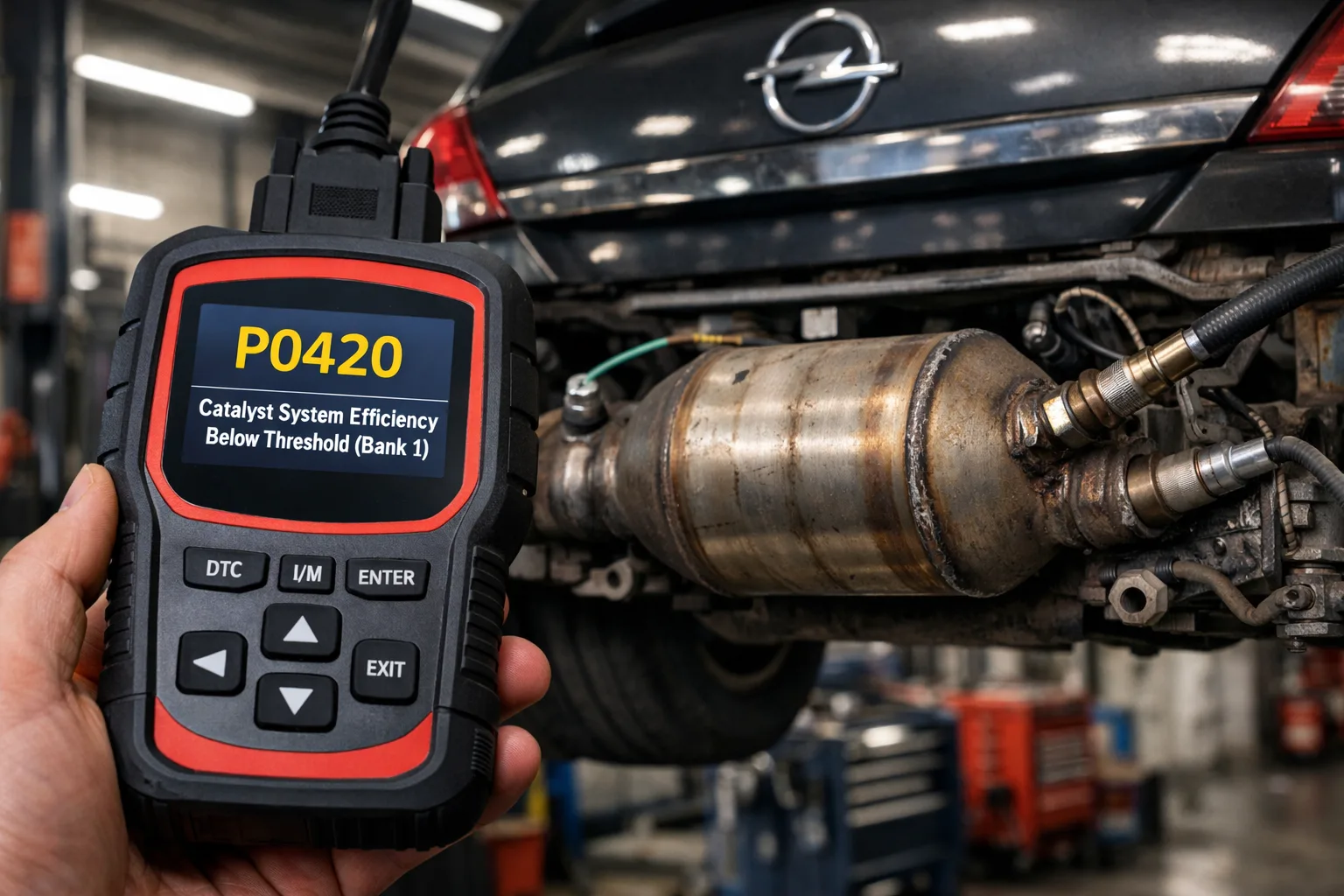
If you own an Opel and suddenly see the P0420 code on your diagnostic scanner, you know something’s wrong with the exhaust system. This OBD2 code indicates catalyst efficiency below threshold, but the reality is far more complex than it seems. In 90% of cases, the problem isn’t actually a dead catalyst – it’s other components affecting it indirectly. I’ve seen hundreds of cases where owners replaced the expensive catalyst only to have the error return after a few hundred kilometers.
In this comprehensive guide, I’ll explain exactly what P0420 means on Opel vehicles, what the real causes are (not just what your mechanic tells you), how to diagnose it properly, and most importantly, how to fix it permanently without emptying your wallet.
What Does P0420 Code Mean on Opel?
The P0420 code technically translates to “Catalyst System Efficiency Below Threshold (Bank 1)” – meaning the catalytic converter isn’t performing at optimal parameters. The ECU (engine control unit) constantly monitors catalyst efficiency by comparing signals from two oxygen sensors (lambda probes): one before the catalyst and one after.
When the difference between these two signals becomes too small, the computer understands the catalyst isn’t eliminating enough harmful emissions and triggers P0420 code. The “Check Engine” warning light illuminates on your dashboard, and the car may enter limp mode (reduced performance safety mode).
Opel Models Frequently Affected:
- Opel Astra G, H, J (1.6, 1.8 petrol)
- Opel Corsa C, D (1.2, 1.4 petrol)
- Opel Insignia (1.6 Turbo, 2.0 CDTI)
- Opel Zafira B (1.8, 1.6 Turbo)
- Opel Vectra C (1.8, 2.2)
Real Causes of P0420 Code on Opel
Most mechanics jump straight to the conclusion “dead catalyst, needs replacement” – and that’s because it’s the most profitable solution for them. But P0420 code Opel can be caused by multiple issues, many of them much cheaper to fix:
1. Faulty or Contaminated Oxygen Sensors (Lambda Probes)
The most frequent culprit! Oxygen sensors age, get covered with carbon deposits, or simply lose accuracy. A faulty lambda sensor sends false data to the ECU, which interprets it as catalyst malfunction.
Associated symptoms:
- Increased fuel consumption (15-20% higher)
- Rough idle
- Power loss during acceleration
- P0420 appears intermittently
Solution: Professional diagnostic testing, sensor cleaning or replacement ($40-80 per sensor for quality aftermarket).
2. Exhaust Leaks Before the Catalyst
A crack in the exhaust pipe or blown manifold gasket allows air into the system. The extra oxygen confuses the lambda sensors and generates false P0420 codes.
How to check:
- Start engine when cold
- Listen for leak sounds (hissing)
- Visually inspect all joints and welds
Solution: Welding repair or gasket replacement ($30-100).
3. Fuel Injection or Ignition Problems
If the injection system isn’t working optimally (dirty injectors, clogged fuel filter) or ignition is weak (worn spark plugs, failing coils), combustion becomes incomplete. Unburned particles reach the catalyst and overload it, leading to P0420 code.
Check:
- Spark plug condition (color, wear)
- Test injectors
- Check fuel pump pressure
- Test ignition coils
Solution: Replace spark plugs ($20-50 set), clean injectors ($60-100), replace faulty coils ($40-80 each).
4. Outdated or Incorrectly Calibrated ECU Software
After engine repairs or sensor replacement, the ECU needs to “relearn” parameters. Some Opel models have known software issues that trigger false P0420 codes.
Solution: Software update at dealer or ECU reprogramming by specialist ($50-150).
5. Actually Damaged Catalyst
Yes, sometimes the catalyst really is the problem. This happens after:
- 150,000+ km (normal wear)
- Constant use of poor-quality fuel
- Engine overheating (coolant leak or blown head gasket)
- Mechanical impact (curbs, rocks)
How to know it’s really the catalyst:
- Metallic rattling noise from catalyst when accelerating
- Serious power loss (blocked catalyst)
- Backpressure test shows excessive pressure
- Visual/endoscopic inspection: melted or broken honeycomb
Solution: Replace with OEM catalyst ($400-900) or quality aftermarket ($200-500). AVOID cheap Chinese units under $150 – you’ll be back with the same problem in 6 months.
Proper P0420 Diagnosis on Opel: Concrete Steps
Don’t start randomly replacing parts. Do professional diagnostics:
Step 1: Read Complete Codes with Professional OBD2 Scanner
Don’t rely on a cheap reader from Amazon. Use professional diagnostic equipment (Launch, Autel, Bosch) or visit someone who has one. Look at:
- Present and pending codes
- Freeze frame data (conditions when error occurred)
- Live data from lambda sensors (voltage, response time)
Useful diagnostic resource: DiagnozaBAM – Complete Opel Error Codes
Step 2: Monitor Lambda Sensors While Driving
Get in the car with the scanner connected and watch live data from both oxygen sensors while driving:
- Sensor 1 (upstream): should oscillate rapidly between 0.1V and 0.9V
- Sensor 2 (downstream): should remain relatively stable at ~0.45V
If sensor 2 oscillates like sensor 1, the catalyst isn’t filtering – it’s dead or sensors are faulty.
Step 3: Backpressure Test
Using a special pressure gauge, check exhaust system pressure:
- At idle: max 1-1.5 PSI
- At 2500 RPM: max 3 PSI
Higher values = blocked catalyst or clogged pipe.
Step 4: Visual Inspection of Exhaust System
Lift the car on a lift/ramps and check:
- Leaks at manifold, gaskets, welds
- Physical condition of catalyst (impacts, excessive rust)
- All wiring and connectors at sensors
Step 5: Test Injection and Ignition
If everything looks OK so far, the problem is elsewhere:
- Engine compression test
- Check timing belt/chain alignment
- Test injectors on bench
- Verify combustion quality (exhaust gas analysis)
Practical Solutions and Real Costs
After identifying the cause, here’s what needs to be done:
Option 1: Faulty Lambda Sensors
- Parts: 2x quality Bosch/NGK sensors ($80-160 total)
- Labor: $30-60
- Total: $110-220
- Resolution time: 1-2 hours
Option 2: Exhaust Leak
- Parts: Gaskets/repair wrap ($15-40)
- Labor: $40-80 (depends on leak location)
- Total: $55-120
- Resolution time: 2-4 hours
Option 3: Injection/Ignition Issues
- Parts: Spark plugs + injector cleaning ($70-130)
- Labor: $50-100
- Total: $120-230
- Resolution time: 3-5 hours
Option 4: Defective Catalyst (Last Resort!)
- Quality aftermarket catalyst: $200-500
- OEM Opel catalyst: $400-900
- Installation labor: $80-150
- Total: $280-1,050
- Resolution time: 4-6 hours
IMPORTANT: Before replacing the catalyst, make sure you’ve fixed ALL other issues. Otherwise, the new catalyst will suffer the same fate within months.
How to Clear P0420 Code and When It Returns
After fixing the identified problem, the P0420 code must be cleared from the ECU using the OBD2 scanner. Simply disconnecting the battery isn’t sufficient on modern Opels.
After clearing:
- Check Engine light goes off
- ECU enters “readiness mode”
- Drive ~30-60 miles in varied conditions (city, highway, freeway)
- If properly fixed, the code won’t return
If the code returns immediately or after a few dozen miles, it means you haven’t found the real cause or the repair is incomplete.
Conclusion: Don’t Rush to Replace the Catalyst!
P0420 code on Opel is one of the most profitable codes for dishonest repair shops. They’ll tell you immediately “dead catalyst, $800,” when the actual problem could be a $40 oxygen sensor or a $50 exhaust leak.
Remember:
- Do COMPLETE diagnostics first (not just code reading)
- Check lambda sensors (90% of cases originate here)
- Look for exhaust leaks
- Test injection and ignition systems
- Catalyst replacement is the LAST option, not first
I’ve seen dozens of cases where owners saved $500-700 simply because they requested a second diagnostic opinion and found a mechanic who DOESN’T just want to sell expensive parts.
Got P0420 on your Opel? Leave a comment with your model and year – I’ll help with free diagnostic guidance!
## Recommended Tool
To properly diagnose this issue, using an OBD2 scanner is highly recommended.
It allows you to read error codes, monitor live data, and identify the real problem quickly without unnecessary repairs.
👉 **Check price on Amazon**
**ANCEL AD310 Classic OBD2 Scanner**
One of the most popular and reliable budget scanners for beginners.
✍️ Author: Bejenaru Alexandru Ionut – [email protected]
🔗 Internal link: https://diagnozabam.ro/sfaturi

