
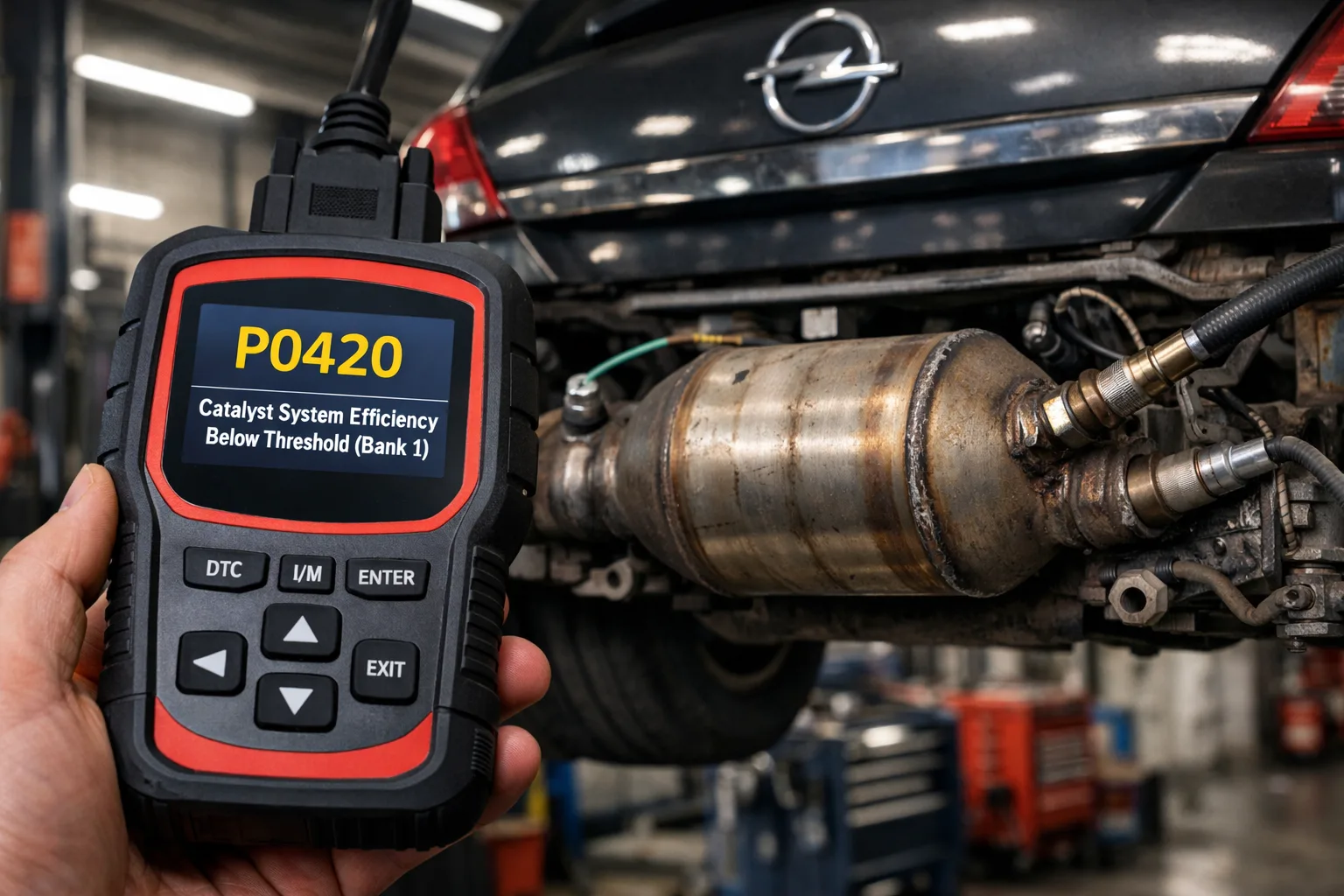
P0420 Code Opel: Don’t Rush to Replace the Catalyst
You plug in the scanner. The code reads P0420. Your mechanic says three words: “dead catalyst, replace it.” Then quotes you $800.
Here’s the problem: in most cases, that’s not actually what’s wrong.
This OBD2 code technically points to the catalytic converter, but the real cause is often something far cheaper — a faulty sensor, a small exhaust leak, or a worn spark plug. This guide explains exactly what P0420 means on Opel vehicles, what actually causes it, and how to diagnose it properly before spending money on the wrong repair.
What Does P0420 Mean on Opel?
The P0420 code technically translates to “Catalyst System Efficiency Below Threshold (Bank 1)” — meaning the catalytic converter isn’t performing at optimal parameters.
The engine control unit (ECU) constantly monitors catalyst efficiency by comparing signals from two oxygen sensors, also called lambda probes: one positioned before the catalyst, one positioned after.
EXHAUST FLOW
      |
[Oxygen Sensor 1 - Upstream]
      |
[Catalytic Converter]
      |
[Oxygen Sensor 2 - Downstream]
      |
ECU COMPARES BOTH SIGNALS
      |
Small difference = Catalyst not filtering efficiently
      |
P0420 CODE TRIGGERED
When the difference between these two signals becomes too small, the ECU interprets this as the catalyst failing to eliminate enough harmful emissions. The Check Engine light illuminates, and in some cases, the car enters limp mode — a reduced performance safety mode.
ℹ️ Technical Note: Sensor 1 (upstream) should oscillate rapidly between 0.1V and 0.9V during normal operation, reflecting the constantly shifting air-fuel mixture. Sensor 2 (downstream) should stay relatively stable around 0.45V, since the catalyst smooths out these fluctuations.
Opel Models Frequently Affected
- Opel Astra G, H, J (1.6, 1.8 petrol)
- Opel Corsa C, D (1.2, 1.4 petrol)
- Opel Insignia (1.6 Turbo, 2.0 CDTI)
- Opel Zafira B (1.8, 1.6 Turbo)
- Opel Vectra C (1.8, 2.2)
The Real Causes of P0420 on Opel
Many repair shops jump straight to “dead catalyst, needs replacement” — partly because it’s the most profitable solution for them. In reality, P0420 can stem from several different issues, many significantly cheaper to fix.
1. Faulty or Contaminated Oxygen Sensors
This is, by far, the most frequent culprit. Oxygen sensors age, accumulate carbon deposits, or simply lose accuracy over time. A faulty lambda sensor sends inaccurate data to the ECU, which then misinterprets it as catalyst malfunction.
Associated symptoms:
- Fuel consumption increased by 15–20%
- Rough idle
- Power loss during acceleration
- P0420 appearing intermittently rather than constantly
ℹ️ Notă tehnică: Wait, staying in English per SOP — Technical Note: A contaminated sensor doesn’t necessarily fail completely; it can send delayed or dampened voltage signals that mimic the exact pattern of a dying catalyst, which is why this cause gets misdiagnosed so often.
Estimated fix: Professional diagnostic testing, sensor cleaning or replacement — $40–80 per sensor for quality aftermarket parts.
2. Exhaust Leaks Before the Catalyst
A crack in the exhaust pipe or a blown manifold gasket allows outside air into the system. This extra oxygen confuses the lambda sensors and generates false P0420 readings.
How to check:
- Start the engine cold.
- Listen for hissing or leak sounds near the manifold.
- Visually inspect all joints and welds.
Estimated fix: Welding repair or gasket replacement — $30–100.
3. Fuel Injection or Ignition Problems
If the injection system isn’t performing optimally — dirty injectors, a clogged fuel filter — or the ignition is weak — worn spark plugs, failing coils — combustion becomes incomplete. Unburned particles then reach the catalyst and overload it, triggering P0420.
What to check:
- Spark plug condition (color and wear pattern).
- Injector function under test.
- Fuel pump pressure.
- Ignition coil performance.
Estimated fix: Spark plug set — $20–50. Injector cleaning — $60–100. Faulty coil replacement — $40–80 each.
4. Outdated or Incorrectly Calibrated ECU Software
After engine repairs or sensor replacement, the ECU needs to “relearn” its operating parameters. Some Opel models have documented software issues that trigger false P0420 codes even when the exhaust system is functioning correctly.
Estimated fix: Software update at a dealer, or ECU reprogramming by a specialist — $50–150.
5. An Actually Damaged Catalyst
Sometimes, the catalyst really is the problem. This typically happens after:
- Over 150,000 km of normal wear.
- Constant use of poor-quality fuel.
- Engine overheating (from a coolant leak or blown head gasket).
- Mechanical impact from curbs or road debris.
How to confirm it’s genuinely the catalyst:
- Metallic rattling noise from the catalyst area during acceleration.
- Serious power loss consistent with a blocked catalyst.
- Backpressure test showing excessive pressure.
- Visual or endoscopic inspection revealing a melted or broken honeycomb structure.
⚠️ WARNING: Avoid cheap aftermarket catalysts under $150. These units frequently trigger the same P0420 code again within months due to substandard internal construction.
Estimated fix: OEM catalyst — $400–900. Quality aftermarket catalyst — $200–500.
Cause Comparison Table
| Cause | Typical Cost Range | Frequency |
|---|---|---|
| Faulty oxygen sensors | $110–220 (parts + labor) | Very common |
| Exhaust leak | $55–120 (parts + labor) | Common |
| Injection/ignition issues | $120–230 (parts + labor) | Common |
| ECU software issue | $50–150 | Occasional |
| Genuinely damaged catalyst | $280–1,050 (parts + labor) | Less common than assumed |
Proper P0420 Diagnosis: Step by Step
Don’t start randomly replacing parts. A structured diagnostic process saves both time and money.
Step 1: Read Complete Codes with a Professional OBD2 Scanner
A cheap consumer-grade reader often isn’t enough. Professional diagnostic equipment provides critical extra data:
- Present and pending codes.
- Freeze frame data — the exact conditions present when the error occurred.
- Live data from both lambda sensors, including voltage and response time.
Step 2: Monitor Lambda Sensors While Driving
With the scanner connected, observe live data from both oxygen sensors during an actual drive:
- Sensor 1 (upstream): should oscillate rapidly between 0.1V and 0.9V.
- Sensor 2 (downstream): should remain relatively stable around 0.45V.
If sensor 2 oscillates in a pattern similar to sensor 1, the catalyst isn’t filtering properly — either it’s genuinely failing, or the sensors themselves are faulty.
Step 3: Backpressure Test
Using a pressure gauge on the exhaust system:
- At idle: should read a maximum of 1–1.5 PSI.
- At 2,500 RPM: should read a maximum of 3 PSI.
Higher readings indicate a blocked catalyst or a clogged exhaust pipe.
Step 4: Visual Inspection of the Exhaust System
With the vehicle on a lift or ramps, check:
- Leaks at the manifold, gaskets, and welds.
- Physical condition of the catalyst — impact damage, excessive rust.
- Wiring and connectors at the oxygen sensors.
Step 5: Test Injection and Ignition
If everything above checks out, the problem likely lies elsewhere:
- Engine compression test.
- Timing belt or chain alignment check.
- Injector bench test.
- Combustion quality verification through exhaust gas analysis.
Practical Solutions and Real Costs
| Scenario | Parts | Labor | Total | Resolution Time |
|---|---|---|---|---|
| Faulty lambda sensors | $80–160 (2x quality sensors) | $30–60 | $110–220 | 1–2 hours |
| Exhaust leak | $15–40 (gaskets/repair wrap) | $40–80 | $55–120 | 2–4 hours |
| Injection/ignition issues | $70–130 | $50–100 | $120–230 | 3–5 hours |
| Defective catalyst (last resort) | $200–900 | $80–150 | $280–1,050 | 4–6 hours |
⚠️ WARNING: Before replacing the catalyst, make sure every other potential cause has been ruled out and fixed. A new catalyst installed alongside an unresolved underlying issue — such as a leaking sensor or weak ignition — will suffer the same fate within months.
How to Clear P0420 and Confirm the Fix Worked
After addressing the identified problem, the P0420 code must be cleared from the ECU using an OBD2 scanner. Simply disconnecting the battery isn’t sufficient on modern Opel models.
After clearing the code:
- The Check Engine light turns off.
- The ECU enters a “readiness mode” for emissions monitoring.
- Drive approximately 30–60 miles under varied conditions — city, highway, and steady cruising.
- If the repair addressed the actual cause, the code will not return.
ℹ️ Technical Note: If the code returns immediately or within a few dozen miles, this strongly suggests the real cause wasn’t identified, or the repair was incomplete rather than the catalyst itself needing replacement.
Frequently Asked Questions
Can I drive with a P0420 code active?
Short-term driving is generally possible, but ignoring the underlying cause risks further damage — especially if unburned fuel or excess oxygen continues reaching the catalyst, which can accelerate its failure.
Why does P0420 keep coming back after I replaced the catalyst?
This typically means an underlying issue — a faulty sensor, exhaust leak, or ignition problem — was never actually fixed. The new catalyst is simply experiencing the same conditions that damaged the original one.
Is it worth getting a second diagnostic opinion?
Yes. P0420 is one of the most profitable codes for repair shops that skip proper diagnosis. A second opinion, ideally from a shop willing to run live sensor data rather than just reading the code, can save hundreds of dollars.
How can I tell if my mechanic is skipping proper diagnosis?
If a catalyst replacement is recommended immediately after just reading the code — without checking lambda sensor live data, testing for exhaust leaks, or inspecting ignition components — that’s a red flag for an incomplete diagnosis.
Conclusion: Don’t Rush to Replace the Catalyst
P0420 on Opel vehicles is one of the most profitable codes for repair shops that don’t run complete diagnostics. The typical response — “dead catalyst, $800” — often turns out to be a $40 oxygen sensor or a $50 exhaust leak instead.
Before authorizing catalyst replacement:
- Insist on complete diagnostics, not just code reading.
- Check the lambda sensors first — this is where most cases originate.
- Rule out exhaust leaks.
- Test the injection and ignition systems.
- Treat catalyst replacement as the last option, not the first.
Owners who request a second diagnostic opinion — from a mechanic willing to look beyond the obvious — frequently save $500–700 by catching the real cause before an unnecessary catalyst replacement.
✍️ Author: Bejenaru Alexandru Ionut – [email protected]
🔗 Internal link: https://diagnozabam.ro/sfaturi
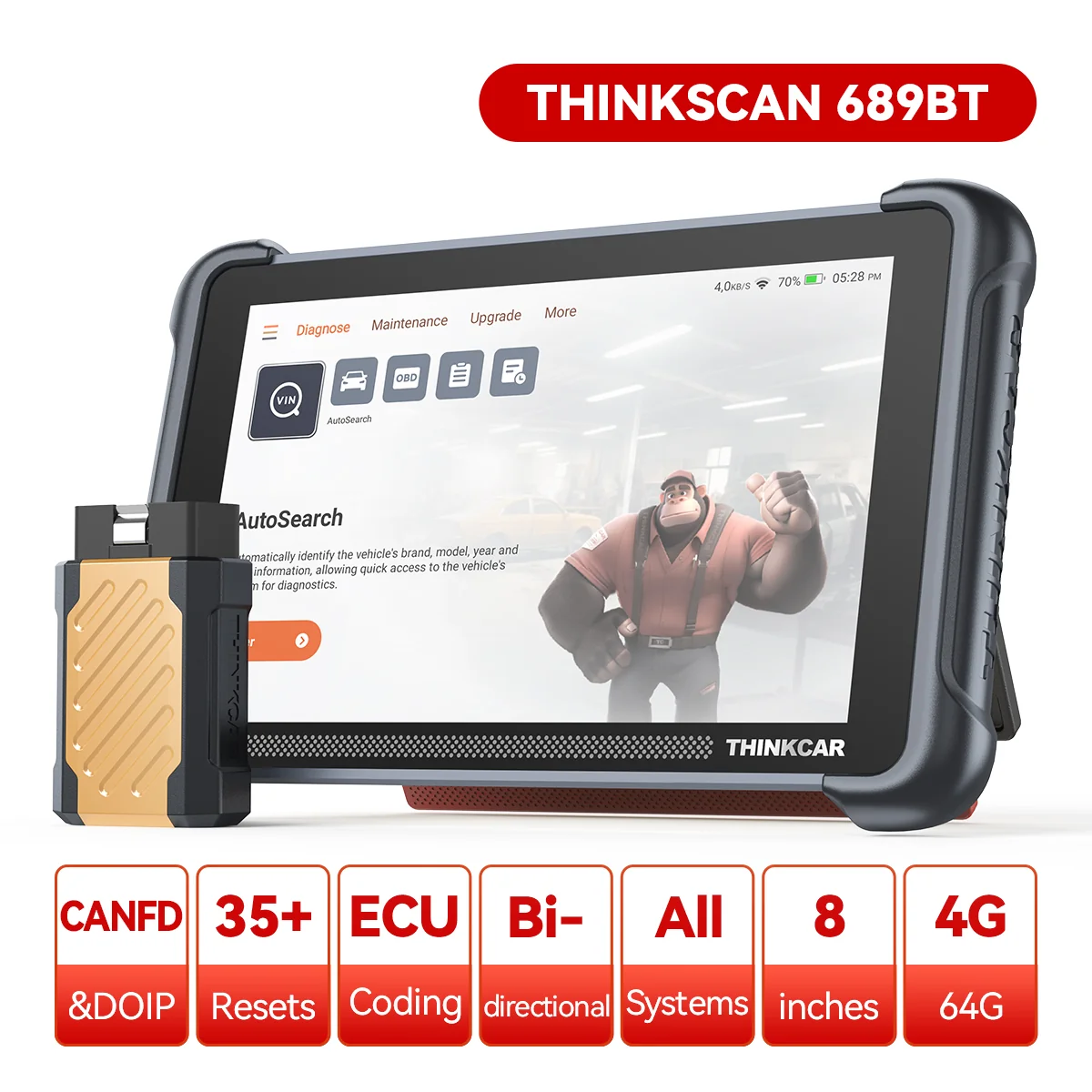
Recommendation: Looking for a professional bi-directional diagnostic tool with full system coverage? Use code DIAGNOZABAM for 10% off.
Transparency note: Affiliate link. Purchasing through it costs you nothing extra. View Thinkcar Deal →
