
Faulty Ignition Coil: Symptoms, Causes, and What to Check First
An engine that starts rough, misfires under load, or simply won’t fire at all often points back to one small, frequently overlooked component: the ignition coil. It doesn’t get much attention until it fails, but when it does, the symptoms can mimic half a dozen other engine problems. Knowing what this part actually does makes it much easier to recognize when it’s the real culprit.
What an Ignition Coil Does
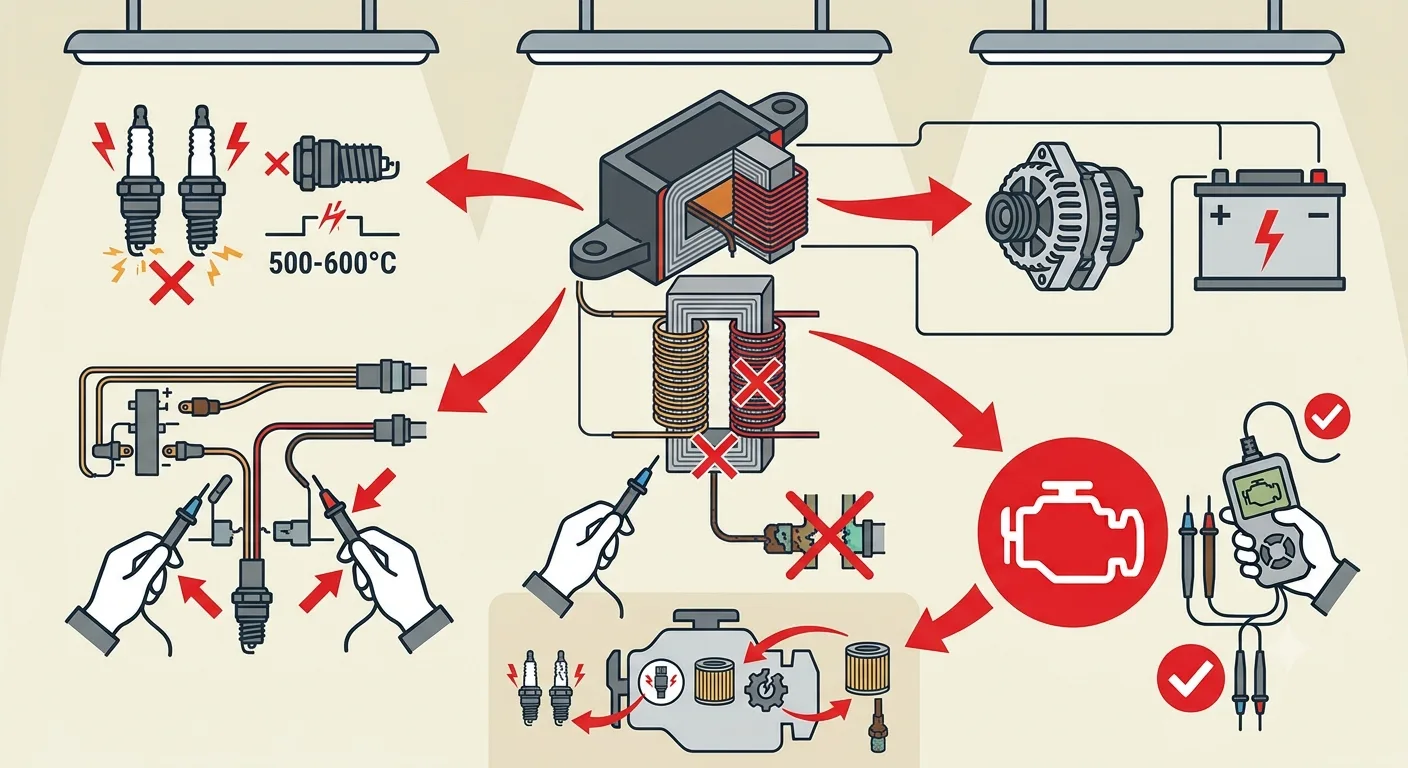
The ignition coil’s job is to convert low-voltage current into the high voltage needed to fire a spark plug. Functionally, it acts as a transformer — taking the 6V or 12V supplied by the battery and stepping it up to somewhere between 15,000 and 20,000 volts, which is the minimum needed to reliably jump the gap at the spark plug and ignite the compressed air-fuel mixture in the cylinder.
The coil sits within the broader electrical system of the vehicle, which includes:
- The alternator, which generates current
- The battery, which stores and supplies electrical energy
- The ignition components, which consume that current to produce spark
- Additional electrical consumers throughout the vehicle
- The wiring connecting everything together
ℹ️ Technical Note: The coil works through electromagnetic induction — interrupting the low-voltage current flowing through it generates the high-voltage current needed for spark. This interruption-and-induction cycle happens continuously while the engine runs.
The full ignition system includes the battery, the ignition coil, the alternator, the distributor shaft with its cam lobes, the contact points, the vacuum capsule and condenser, and the spark plugs themselves. Electric vehicles use a comparable but distinct setup, with separate low-voltage and high-voltage circuits handling the same basic function.
Spark Plug Temperature and Why It Matters
Spark plugs run hottest near the combustion chamber and stay cooler toward the exposed end, and that temperature gradient affects how well they perform. Ideal operating temperature sits around 500–600°C, the range at which carbon deposits burn off naturally.
Run hotter than that, and secondary ignition events start occurring — the engine begins losing power and running intermittently.
Choosing the correct plug type depends on the engine:
- High-compression, high-RPM engines need colder plugs
- Slower, lower-compression engines need hotter plugs to prevent oil deposits from building up on the electrodes
- Older or worn engines also benefit from hotter plugs for the same reason
Common Ignition Coil Failures and Their Causes
The most frequently reported symptoms of ignition system trouble include:
- Engine knocking at low or high RPM
- Misfires when revving the engine
- Irregular ignition at higher RPM
- Engine overheating
- In severe cases, complete failure to ignite
Knocking at Low RPM
This is often traced back to worn or damaged spark plugs. If a broken centrifugal regulator spring is the cause instead, replacement isn’t always mandatory — it depends on the severity.
The coil itself sits inside an epoxy resin housing, sealed with screws, and contains transformer oil for cooling. Some coil designs include an internal variator specifically to help prevent overheating.
Knocking at Higher RPM
This has multiple possible causes:
- Incorrect regulator adjustment
- Excessive ignition timing advance
- A weakened or broken spring behind the diaphragm
Timing advance can be corrected with dedicated diagnostic equipment. A broken spring, on the other hand, requires replacement — there’s no adjustment workaround.
Weak or Irregular Ignition
Persistent irregular firing is commonly caused by one or more of the following:
- Oxidized contact points
- A stuck rotor arm (requires thorough cleaning)
- Misaligned points, requiring the contacts to be reset to their normal position
- Faulty condenser insulation, requiring replacement
- Degraded high-voltage wiring
- Leaks from a damaged insulating cap
Additional contributing factors include loosened ignition wire connections, a dirty or leaking insulating cap, and contact points that no longer close with enough pressure — in which case the spring should be checked and replaced if needed.
Engine Overheating
Overheating linked to the ignition system is usually caused by excessively delayed timing, tied to the regulator. If this occurs, both the ignition conduction and the intake valve should be inspected.
Does This Vary by Car Brand?
The core symptoms stay consistent across makes and models — Dacia Logan, Golf 4, Opel Astra, BMW, Ford, or Volkswagen all show the same underlying patterns. Minor variations exist depending on the specific model and its features, but the fundamentals drivers should watch for remain the same regardless of brand.
How to Tell If Your Ignition Coil Is Actually Failing
Many drivers overlook early warning signs simply because they’re not obvious while driving. In more serious cases, the engine will start with repeated interruptions — a much harder symptom to miss.
Irregular firing specifically at high RPM often points to a failing rotor arm or condenser, both of which require replacement. Irregular opening of the contact points at the distributor can also indicate an ignition coil problem, in which case the mounting screws need to be readjusted and tightened.
⚠️ WARNING: Repeated misfiring and irregular ignition shouldn’t be treated as a minor annoyance. Left unaddressed, this pattern is one of the more common causes of complete engine shutdown in gasoline-powered vehicles.
Preventing Ignition System Failures
Regular inspection is the most reliable way to avoid escalating problems. Any unusual engine behavior is worth having checked by a specialist before it develops into something more serious.
Practical maintenance points:
- High-voltage wires and their connections degrade over time depending on vehicle age and maintenance history. Moisture or dust penetrating the insulation significantly weakens ignition power.
- Spark plugs are consumable parts and need replacement on a schedule tied to their wear level. A change in engine sound, or a noticeable increase in fuel consumption, are both signs they should be inspected.
- Cracked or damaged spark plugs should be checked carefully, and cylinders inspected to prevent foreign debris from entering the combustion chamber.
- Specific diagnostic tests, such as a CLIP test or a compression test, help catch ignition coil problems before they cause a breakdown.
ℹ️ Technical Note: If spark plugs have already been inspected and replaced but the problem persists, the ignition coil itself should be checked in detail — a small internal component failure or wear point inside the coil is often the actual root cause.
Bottom Line
Ignition system failures account for more than half of the breakdowns seen in gasoline engines, yet the ignition coil remains one of the most neglected components on a vehicle. Routine inspection is inexpensive relative to the cost of a full breakdown, and catching a failing coil early — through a specialist check or a straightforward compression test — is almost always cheaper than waiting for the symptoms to get worse.
✍️ Author: Bejenaru Alexandru Ionut – [email protected]
🔗 Internal link: https://diagnozabam.ro/sfaturi

Recommendation: Looking for a professional bi-directional diagnostic tool with full system coverage? Use code DIAGNOZABAM for 10% off.
Transparency note: Affiliate link. Purchasing through it costs you nothing extra. View Thinkcar Deal →
