
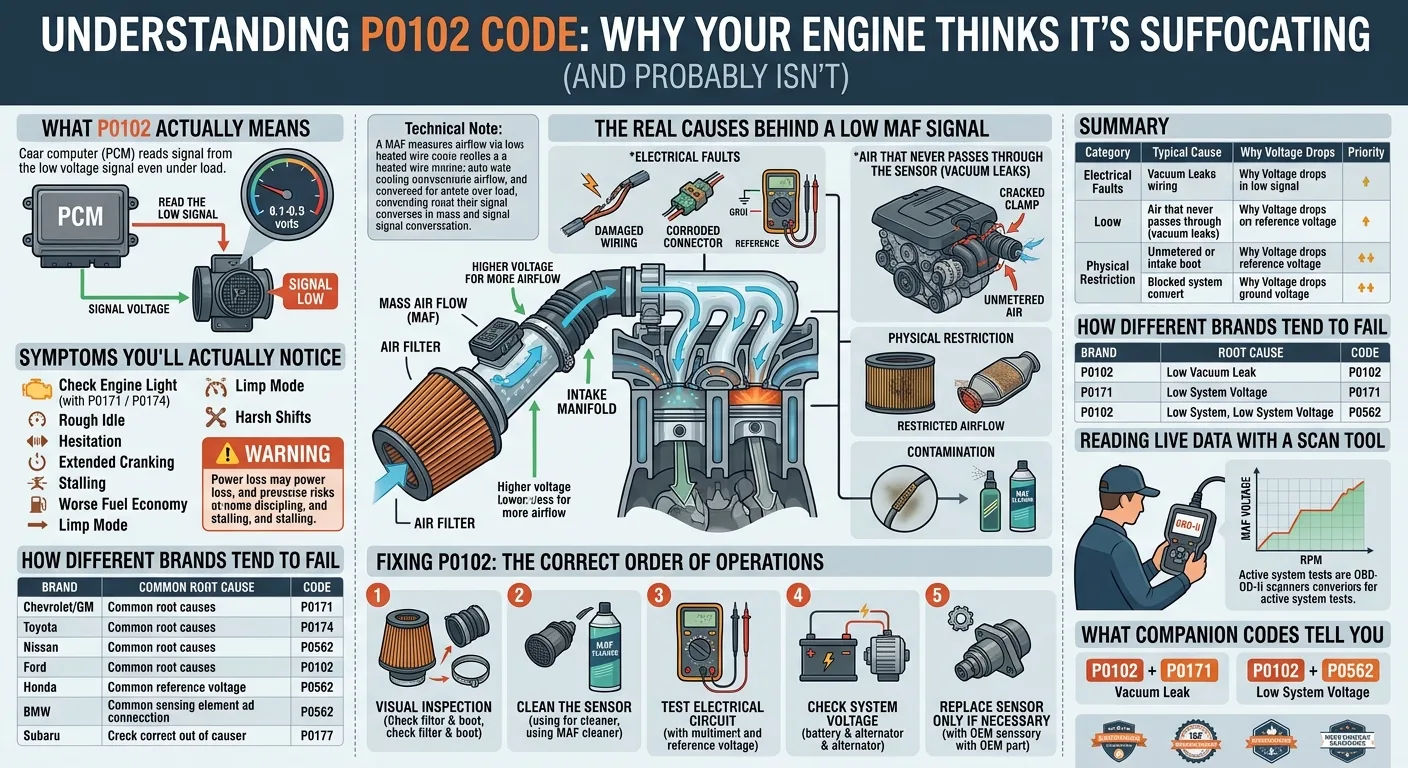
P0102 Code: Why Your Engine Thinks It’s Suffocating (And Probably Isn’t)
Your check engine light comes on. You plug in a scanner. P0102 stares back at you. Before you order a new mass air flow sensor, understand this: the code doesn’t say the sensor is broken. It says the signal is low. Those are two very different problems, and confusing them is how people spend $300 on a part they didn’t need.
What P0102 Actually Means
The powertrain control module constantly reads a voltage signal from the MAF sensor. That signal tells the computer how much air is entering the engine, which in turn determines how much fuel to inject.
P0102 triggers when that signal drops below roughly 0.1 to 0.5 volts on gasoline engines, and stays there even when the engine is under load or revving. The computer expects more air movement than the signal reports. Something is wrong with the reading — not necessarily the sensor doing the reading.
This is a generic code, meaning the core definition applies across manufacturers. Some brands layer extra sub-codes on top or adjust the exact trigger thresholds, but the fundamental logic stays the same everywhere.
ℹ️ Technical Note: A MAF sensor works by measuring how much a heated wire cools as air passes over it. More airflow means more cooling, which the sensor converts into a higher voltage or frequency signal. Less airflow — real or apparent — means a lower signal.
The Real Causes Behind a Low MAF Signal
Electrical Faults Come First
Because this is a circuit code, wiring problems deserve the first look, not the last. Common culprits include a missing or weak 5-volt reference, a poor ground connection, corroded connector pins, or wire damage near a harness bend point.
None of these require a new sensor. They require a multimeter and patience.
Air That Never Passes Through the Sensor
If air enters the engine downstream of the MAF — through a cracked intake boot, a failed intake manifold gasket, a loose clamp, or a PCV leak — the engine breathes more air than the sensor ever registers. The computer sees a mismatch and assumes airflow is too low.
This is the single most common real-world cause of P0102, and it’s also the one most often missed because the sensor itself is completely fine.
Physical Restriction
A badly clogged air filter, a collapsed intake duct, or even a clogged catalytic converter can reduce actual airflow enough to drag the signal down. Over-oiled aftermarket cotton filters are a frequent and underrated offender here, since excess oil migrates onto the sensing element itself.
Contamination Rather Than Failure
Dust, oil vapor, or road grime settling on the sensing wire changes how it reacts to airflow, producing an artificially low reading. This is often fixed entirely with a proper MAF cleaner — no parts required.
| Category | Typical Cause | Why Voltage Drops | Priority |
|---|---|---|---|
| Electrical | Broken wire, bad ground | Signal degrades before reaching PCM | Highest |
| Vacuum Leak | Cracked intake boot, gasket failure | Air bypasses the sensor | Highest |
| Restriction | Clogged filter, blocked converter | Less air physically reaches sensor | Moderate |
| Contamination | Oil film, dust on element | Reduced heat transfer accuracy | Moderate |
Symptoms You’ll Actually Notice
- Check engine light, sometimes alongside P0171 or P0174
- Rough or unstable idle
- Hesitation or stumbling under acceleration
- Extended cranking or occasional backfire on startup
- Stalling, especially with an accompanying vacuum leak
- Noticeably worse fuel economy
- Limp mode with reduced power, more common on GM and some European models
- Harsh or mistimed transmission shifts on certain GM and Ford automatics
⚠️ WARNING: Limp mode and stalling aren’t just inconvenient. Losing power mid-merge or stalling at an intersection creates a genuine safety hazard, not just a mechanical annoyance.
How Different Brands Tend to Fail
| Brand | Common Root Cause | Associated Codes | Notes |
|---|---|---|---|
| Chevrolet/GM | Intake leaks, wiring age, contamination | P0171, P0101 | Prone to limp mode; throttle body sensitive |
| Toyota | Contamination, filter installation errors | P0171 | Sensors generally durable; usually maintenance-related |
| Nissan | Higher sensor failure rate on older units | P0171, P0100 | Age-related degradation more common |
| Ford | PCV leaks, cracked intake pipes | P0171, P2195 | Vacuum leaks are the dominant cause |
| Honda | Intake sealing issues | P0171 | ECM reacts strongly to air-fuel shifts |
| BMW | Intake leaks, CCV issues | 2A2C, 2AAF | Often paired with unstable idle |
| Subaru | Poor filter housing seal | P0171 | Frequently appears right after a filter change |
Is It Safe to Keep Driving?
Short distances to a repair shop are reasonable in a pinch. Extended driving is not. The immediate risk is stalling in traffic or losing power during a merge. The longer-term risk is worse: a sustained lean condition from bad airflow data can overheat and destroy a catalytic converter, contaminate oxygen sensors, or cause lean misfires that damage pistons and valves over time.
A code that starts as a $30 cleaning job can become a $1,500 repair if ignored long enough.
Fixing P0102: The Correct Order of Operations
Replacing the sensor first is the most expensive way to solve this. Work through these steps in sequence instead.
Step 1 — Visual inspection, no tools required. Check the air filter for clogging or oil staining. Inspect the rubber boot between the MAF and throttle body for cracks or loose clamps. Look over the vacuum hoses running to the intake manifold.
Step 2 — Clean the sensor. Remove it and spray the sensing element 10 to 15 times with a dedicated MAF cleaner. Never use carburetor cleaner or compressed air, both of which can damage the sensing coating. Let it air-dry completely, roughly ten minutes, before reinstalling.
Step 3 — Test the electrical circuit. With the key on and engine off, check for 12V supply and 5V reference at the connector. Confirm ground resistance is under 0.2 ohms. With the engine running, the signal should sit around 0.5 to 1.5 volts at idle and climb steadily with RPM.
Step 4 — Check system voltage. A weak battery or failing alternator can distort the MAF signal even when the sensor and wiring are perfectly fine. If voltage sits below 12V, address the charging system before touching the sensor.
Step 5 — Replace the sensor only if everything else checks out. Choose OEM-grade parts from established manufacturers. Cheap, poorly calibrated aftermarket units frequently trigger a new P0171 lean code almost immediately after installation.
Reading Live Data With a Scan Tool
A scanner that supports live data streaming turns guesswork into confirmation. After reading and recording the code, open the live MAF data feed and watch the voltage at idle and while revving. It should rise smoothly with engine speed; sudden drops or flat, unchanging readings point toward wiring faults or intake leaks rather than simple contamination.
Some diagnostic tools also support active system tests, allowing a technician to simulate load conditions and compare sensor response against manufacturer specifications — useful for separating an internal sensor fault from an external airflow problem.
What Companion Codes Tell You
- P0102 alone usually points to contamination or a minor wiring issue.
- P0102 with P0171 or P0174 is a strong signal of unmetered air entering through a vacuum leak.
- P0102 with P0562 (low system voltage) often means the real problem is a weak battery or failing alternator, not the sensor at all.
Why the Code Comes Back After Replacement
A surprising number of drivers replace the MAF sensor only to see P0102 return within days. The reasons, ranked by likelihood:
- An intake or vacuum leak was never addressed, so unmetered air keeps distorting the reading regardless of sensor condition.
- Wiring or connector damage was never fixed, so the new sensor still can’t send a clean signal.
- A low-quality aftermarket replacement was poorly calibrated from the factory.
- Battery or alternator voltage issues were never resolved.
- Carbon buildup on the throttle body affects airflow downstream of the sensor.
- The ECU’s learned fuel trim values were never reset, so it continues operating on skewed data.
Replacing the sensor a second time rarely helps if the underlying cause was never identified in the first place.
Common Misdiagnosis Patterns
The most expensive mistake is treating P0102 as proof of sensor failure. Real-world cases — including well-documented ones on GM V8 trucks — show intake manifold gasket leaks causing identical symptoms, with the sensor itself working perfectly. Wiring stress near the connector, restriction downstream of the sensor, and dramatic-feeling symptoms like backfiring or stalling can all mislead an owner into assuming catastrophic engine damage when the actual fix costs under fifty dollars.
Before replacing anything, work through leaks, wiring, live data, and fuel trims. The sensor should be the last suspect, not the first.
✍️ Author: Bejenaru Alexandru Ionut – [email protected]
🔗 Internal link: https://diagnozabam.ro/sfaturi

Recommendation: Looking for a professional bi-directional diagnostic tool with full system coverage? Use code DIAGNOZABAM for 10% off.
Transparency note: Affiliate link. Purchasing through it costs you nothing extra. View Thinkcar Deal →
