
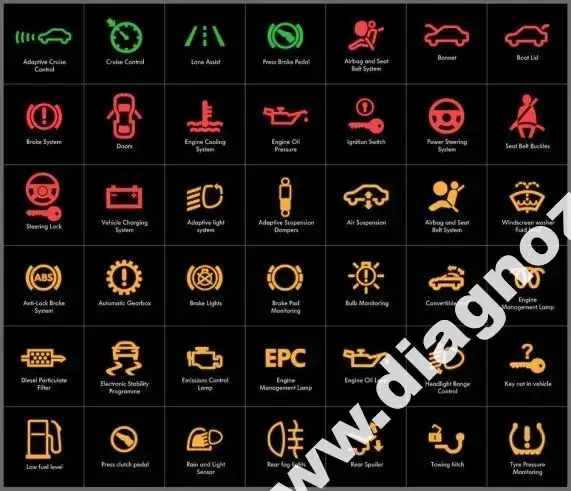
Deciphering the Dash: The Ultimate Guide to Dashboard Warning Lights
Modern cars are effectively computers on wheels, constantly monitoring thousands of parameters to ensure your safety and the vehicle’s health. When something goes wrong, your dashboard speaks to you through symbols. While some are self-explanatory, others—like the dreaded “Check Engine” light—can be cryptic.
Understanding these symbols can save you from a massive repair bill or, more importantly, a dangerous breakdown. Here is everything you need to know about dashboard warning lights in 2026, including specific icons for the latest Electric Vehicles (EVs).
The Universal Traffic Light System
Before diving into specific symbols, you must understand the color-coding system. Most manufacturers follow a standard “traffic light” logic to indicate the level of urgency:
| Color | Meaning | Action Required |
| Red | Critical Warning | Stop the car as soon as it is safe. A serious fault has occurred. |
| Amber / Yellow | Advisory/Non-Critical | Something is wrong or needs maintenance soon. You can drive, but see a mechanic. |
| Green / Blue | Information | A system is currently active (e.g., high beams, cruise control, or turn signals). |
The “Must-Know” Safety Lights (Red & Amber)
1. Engine Management (Check Engine)
-
Symbol: An outline of an engine.
-
Meaning: This is the “catch-all” light for the emission control and engine management systems. It could be a loose gas cap or a serious engine misfire.
-
Action: If it’s solid amber, get a diagnostic scan soon. If it’s flashing, stop immediately—this indicates a misfire that can destroy your catalytic converter.
2. Oil Pressure Warning
-
Symbol: An old-fashioned oil can with a drop.
-
Meaning: Your engine has lost oil pressure. This is not a “low oil level” light; it means oil isn’t circulating.
-
Action: Stop immediately. Running an engine without oil pressure will seize the motor in seconds.
3. Brake System / Parking Brake
-
Symbol: An exclamation mark inside a circle.
-
Meaning: Either your parking brake is still engaged, or your brake fluid is dangerously low.
-
Action: Release the handbrake. If the light stays on, your brakes may fail. Pull over and check the fluid level.
4. Engine Temperature (Thermometer)
-
Symbol: A thermometer dipped in liquid.
-
Meaning: Your engine is overheating. This could be due to a leak, a broken fan, or a failed water pump.
-
Action: Pull over and turn off the engine. Never open the radiator cap while the engine is hot, as pressurized steam can cause severe burns.
5. Battery / Charging System
-
Symbol: A small rectangular battery with plus and minus signs.
-
Meaning: The car’s electrical system is not being charged by the alternator (or the DC-DC converter in EVs).
-
Action: Turn off non-essential electronics (AC, radio) and drive to a service center. Your car will eventually lose all power and stop.
Modern & Electric Vehicle (EV) Specific Symbols
As we move into 2026, dashboards are featuring new icons specifically for electrified powertrains.
6. The “Turtle” (Limited Power Mode)
-
Symbol: An amber tortoise inside a circle.
-
Meaning: The car has entered “Limp Mode.” This happens in EVs or Hybrids when the battery is critically low, too hot, or there is an electrical fault.
-
Action: Drive carefully to the nearest charging station or service center. Your top speed will be significantly restricted.
7. “Ready” Indicator
-
Symbol: The word “READY” in green, often with an arrow.
-
Meaning: Since EVs are silent, this confirms the vehicle is “on” and ready to drive.
-
Action: No action needed—it’s the EV equivalent of hearing an engine idle.
8. General Electrical Fault
-
Symbol: A car outline with a vertical exclamation mark.
-
Meaning: A fault has been detected in the high-voltage battery, motor, or wiring.
-
Action: If amber, visit a dealer. If red, stop the vehicle safely—the high-voltage system may shut down entirely.
Common Maintenance Indicators
-
Tire Pressure (TPMS): A yellow horseshoe with an exclamation mark. One of your tires is under-inflated.
-
ABS Warning: The letters “ABS” in a circle. Your anti-lock brakes are disabled, but normal braking still works. Take extra care in the rain.
-
Airbag Warning: A seated passenger with a large circle (airbag) in front of them. The SRS system is faulty and may not deploy in a crash.
Pro-Tip: The “Bulb Check”
When you first turn your ignition to the “ON” position (without starting the engine), most dashboard lights will illuminate for a few seconds. This is a Bulb Check to show you that the warning lights themselves are working. If a light doesn’t come on during this phase but your manual says it should, the bulb or the sensor circuit might be faulty.
Summary Checklist:
-
Red light? Stop the car.
-
Amber light? Check the manual/mechanic soon.
-
Flashing light? Urgent—stop as soon as possible.
✍️ Author: Bejenaru Alexandru Ionut – [email protected]
🔗 Internal link: https://diagnozabam.ro/sfaturi

Recommendation: Looking for a professional bi-directional diagnostic tool with full system coverage? Use code DIAGNOZABAM for 10% off.
Transparency note: Affiliate link. Purchasing through it costs you nothing extra. View Thinkcar Deal →
