
Bugatti W16 Mistral Fly Bug: When Hypercar Engineering Becomes Art
The Bugatti W16 Mistral Fly Bug is not just another special-edition hypercar. It is a one-off Sur Mesure creation that shows how far Bugatti can take personalization when money, craftsmanship and imagination meet inside the same project.
Presented as the latest bespoke masterpiece from Bugatti’s Sur Mesure division, the W16 Mistral Fly Bug was created for a loyal collector whose private collection already includes several nature-inspired Bugatti commissions. According to Bugatti, this car joins the Veyron Grand Sport Vitesse Hellbug, the Chiron Hellbee and the Divo Lady Bug, forming a four-car story linked by the beauty and complexity of the natural world.
The inspiration this time is the dragonfly. That may sound delicate for a 1,600 PS roadster, but in Bugatti language it makes sense. A dragonfly is light, precise, fast and visually striking. The Fly Bug tries to translate exactly that into paint, pattern, material and detail.
Apple Face Modificări în Securitate pentru a Proteja Utilizatorii împotriva Furturilor de iPhone.
A Dragonfly-Inspired Bugatti
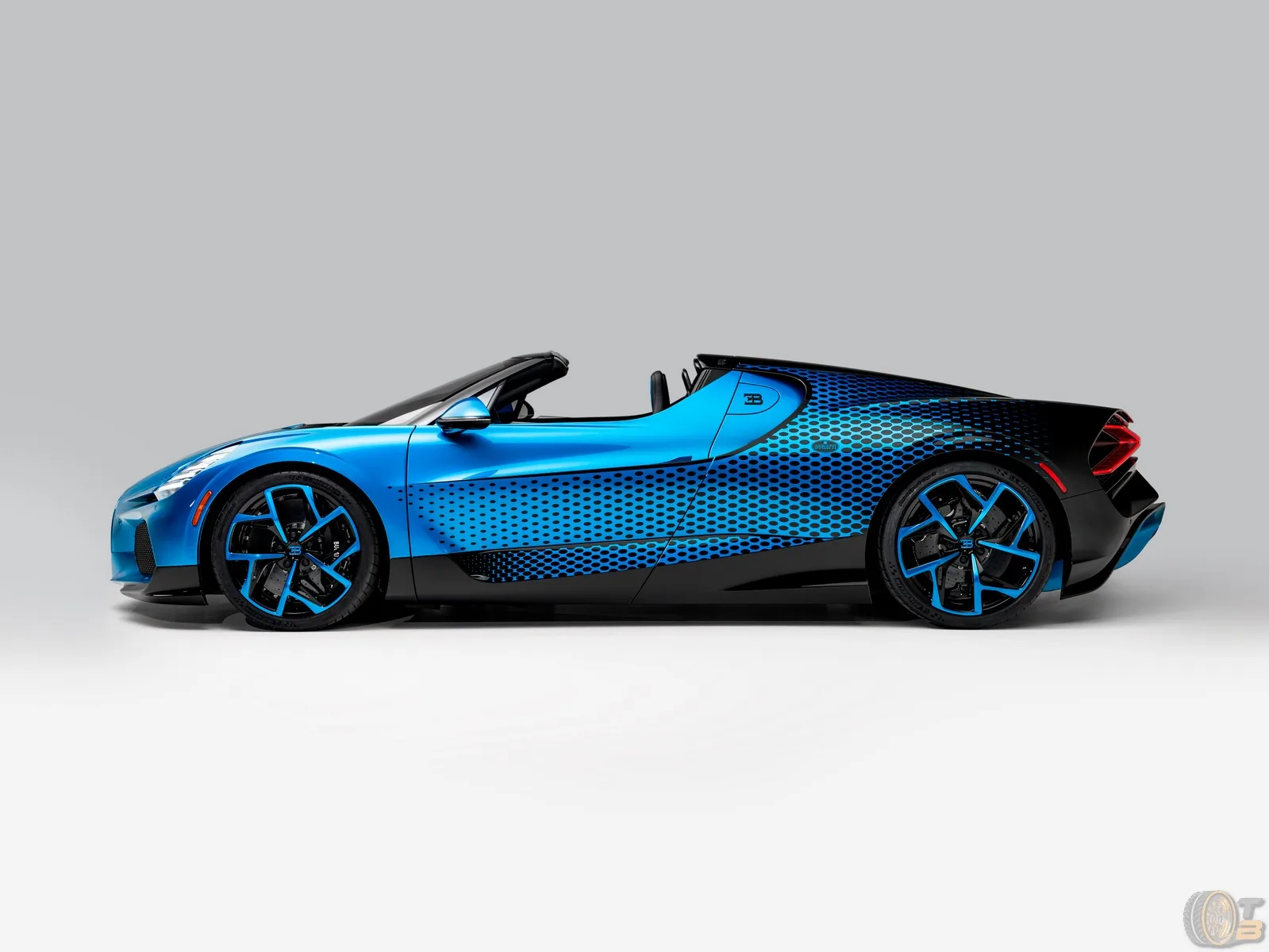
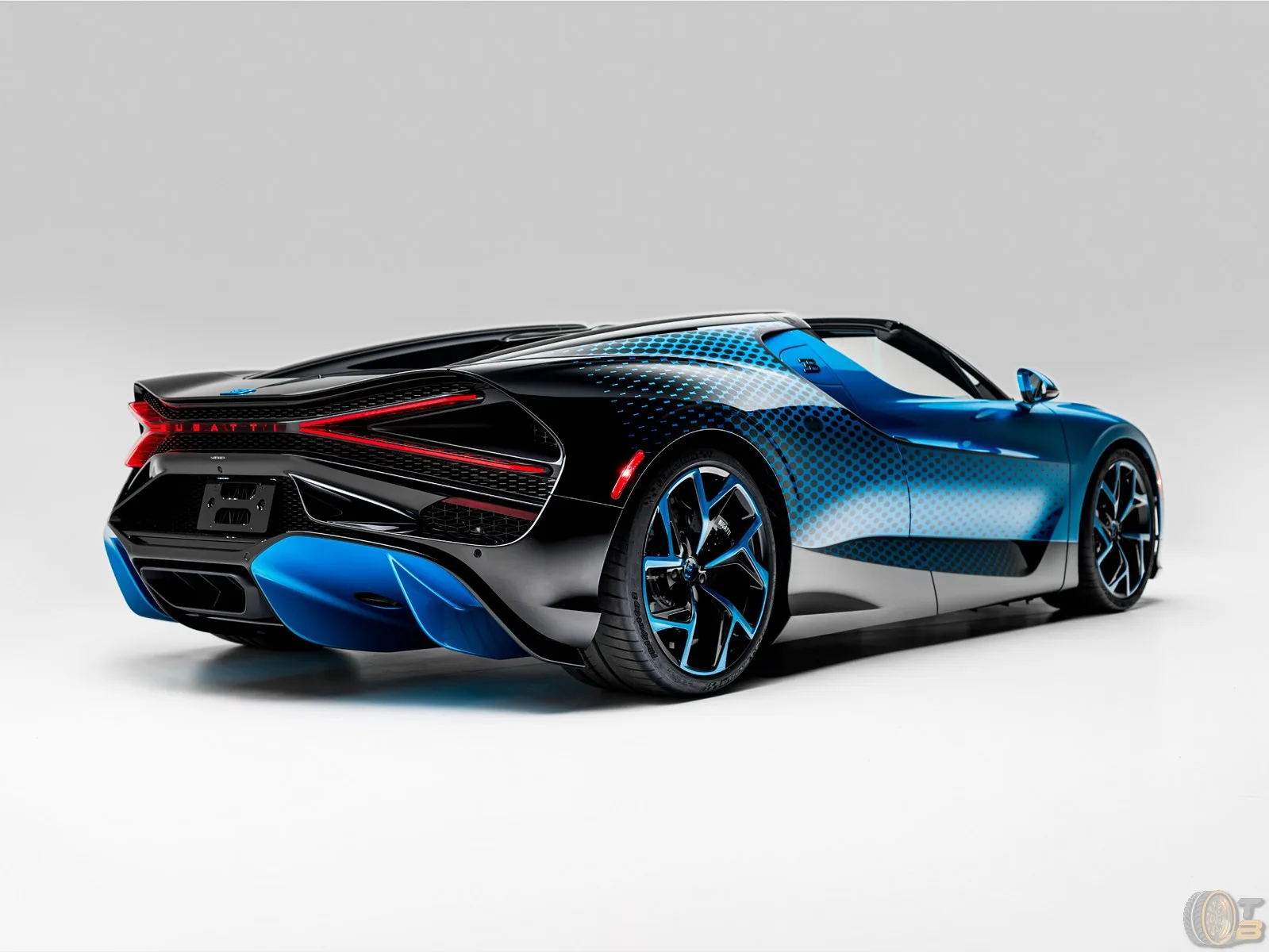
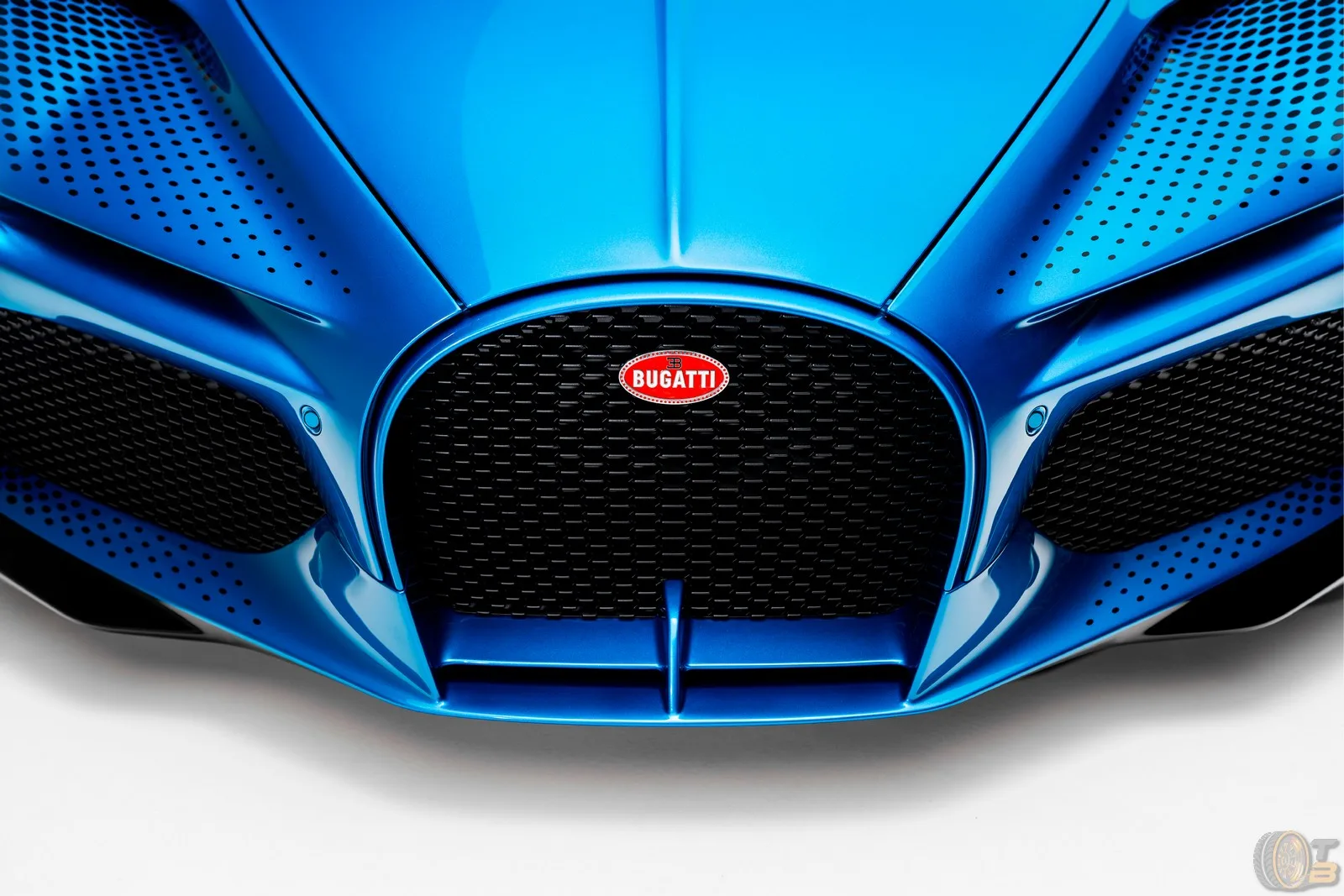
The most obvious feature of the Bugatti W16 Mistral Fly Bug is its unique exterior finish. Bugatti created a bespoke color called Dragonfly Blue, developed specifically for this commission. The shade shifts between blue and turquoise depending on the light and viewing angle, giving the car a changing visual effect similar to the iridescent wings of a dragonfly. The same color theme was also carried onto the wheels, even though matching the finish across different materials required a dedicated process.
But the paint alone is not the full story. Bugatti’s design team also developed a special ellipse pattern that spreads across the bodywork. The pattern becomes denser toward the rear of the car and fades into the darker air intake areas. This gives the Fly Bug a sense of movement even when it is standing still.
The idea is clever because it avoids turning the car into a simple painted showpiece. Instead, the graphic treatment works with the shape of the Mistral. The body already has strong aerodynamic volumes, deep intakes and dramatic rear surfaces. The ellipse pattern adds another layer of visual depth without hiding the engineering beneath.
Part Of A Private Bugatti Collection
What makes this car even more interesting is that it was not designed as a random one-off. It is part of a larger private collection built around a recurring nature theme.
The earlier cars in this collector’s Bugatti story include the Veyron Grand Sport Vitesse Hellbug, the Chiron Hellbee and the Divo Lady Bug. Each car used a different interpretation of fauna-inspired design. The Divo Lady Bug, for example, used an extremely complex geometric pattern made from around 1,600 individual shapes, according to Bugatti.
The W16 Mistral Fly Bug continues that idea but gives it a more fluid and elegant identity. It feels less aggressive than a track-focused Divo and more like a moving sculpture. That fits the Mistral perfectly, because this model is already positioned as the ultimate open-top expression of the W16 era.
The Bugatti Macaron Hidden In The Pattern
One of the most technically demanding parts of the project was the integration of the Bugatti Macaron into the ellipse graphic on the side of the car. The Macaron is Bugatti’s famous oval emblem, normally associated with the horseshoe grille and the brand’s identity.
For this commission, the customer wanted the Macaron woven into the painted pattern on the car’s flank. Bugatti says this was done for the first time and required careful adjustment of scale and placement so the tiny dots, lettering and overall shape could be reproduced correctly inside the graphic design.
This kind of detail is exactly why Sur Mesure cars are different from normal customization. It is not just about choosing a color, leather and wheels. It is about creating elements that may require new techniques, new material applications and months of coordination between designers, painters, material specialists and engineers.
Volkswagen, Audi, Porsche și Scout Vor Beneficia de Încărcare la Stațiile Tesla Începând cu 2025
A Cabin That Continues The Exterior Theme
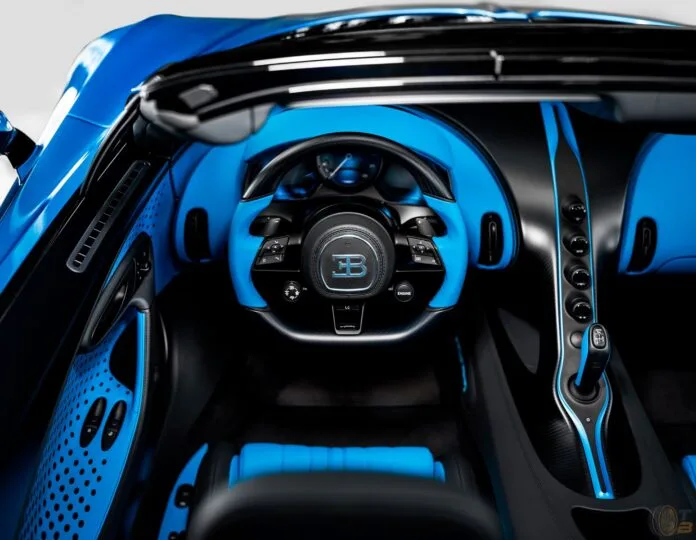
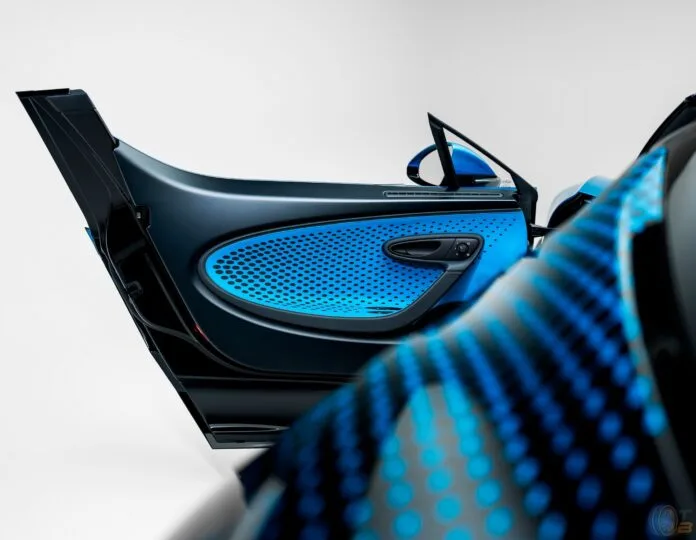
Inside, the Bugatti W16 Mistral Fly Bug continues the dragonfly-inspired theme with an exclusive material treatment. Bugatti developed a multi-layered interior material combining leather over Alcantara in a geometric pattern. The material is color-matched to Dragonfly Blue and finished in a way that gives it a three-dimensional quality.
The ellipse motif is also used on the door panels. What makes this special is that Bugatti applied the graphic pattern across both the door panel face and the armrest area, something the brand says it had not done before. Because these areas are curved and touched frequently, the execution had to be precise. A luxury hypercar interior cannot simply look good in photos; the material has to sit perfectly, feel correct and age properly.
Another important detail is the gear selector. Like other W16 Mistral models, it features the famous Dancing Elephant, a reference to Rembrandt Bugatti and the brand’s historic connection to animal sculpture. In this car, that detail fits especially well because the entire project is based on the owner’s appreciation for the natural world.
The W16 Mistral Base Is Already Extreme
Even before the Fly Bug treatment, the Bugatti W16 Mistral was one of the most important modern Bugatti models. It represents the final roadgoing appearance of the legendary W16 engine, a powertrain that defined the brand from the Veyron era through the Chiron generation.
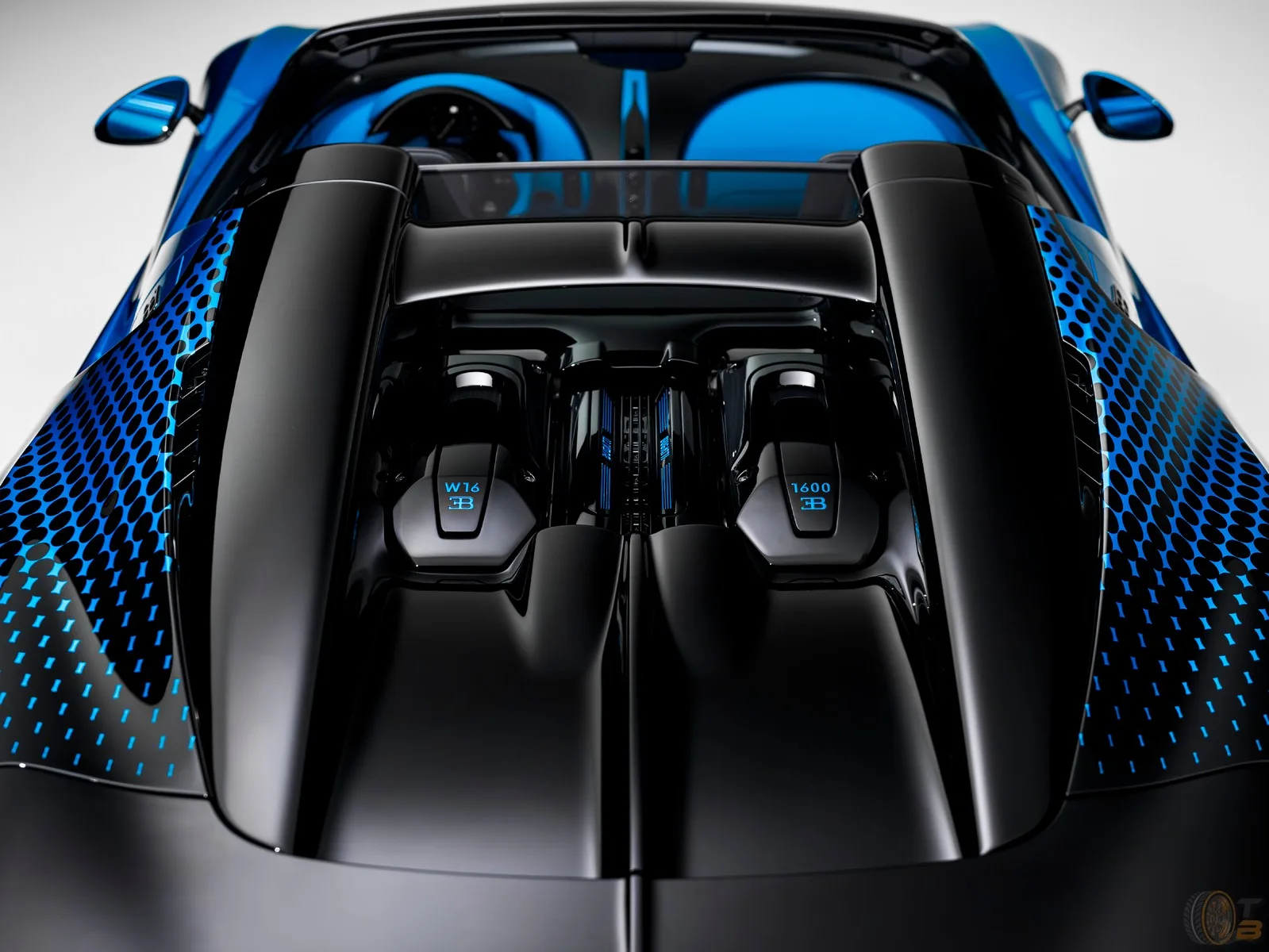
The W16 Mistral uses the 8.0-liter quad-turbo W16 engine with 1,600 PS. Bugatti previously described the model as capable of more than 420 km/h in Top Speed mode, while still requiring careful aerodynamic and thermal management because it is an open-top car.
That detail matters. Removing the roof from a hypercar is not simple, especially when the car is designed to operate at extreme speed. Bugatti had to manage airflow, cooling, stiffness, rollover protection and cabin experience while keeping the roadster elegant. The Mistral uses dramatic rear intakes behind the occupants and an aerodynamic structure shaped to support both cooling and high-speed stability.
Limited, Sold Out And Extremely Exclusive
The standard Bugatti W16 Mistral was never meant to be common. Bugatti confirmed that only 99 examples would be built, each priced from 5 million euros net, and the entire production run was already sold out.
The Fly Bug goes far beyond that. As a one-off Sur Mesure commission, it is not just one of 99 Mistrals. It is a unique car within an already limited series. That gives it a different collector value. It is not only rare because Bugatti built few Mistrals; it is rare because this specific configuration, story and design execution belong to one customer.
For collectors, that matters enormously. Modern hypercars are no longer judged only by horsepower and top speed. Provenance, individuality, story and specification can be just as important. A normal W16 Mistral is already a historic car. A W16 Mistral Fly Bug is closer to a commissioned artwork on wheels.
Why The Fly Bug Matters
The Bugatti W16 Mistral Fly Bug matters because it shows the direction of ultra-luxury car personalization. At this level, customers are not simply asking for exclusive colors. They are asking for complete stories.
This car has a theme, a place inside a collection, a custom paint, a unique pattern, a special interior material treatment and technical firsts for Bugatti’s customization team. It is also based on one of the last great combustion-engine hypercars of the modern era.
In a market increasingly focused on electrification, software and efficiency, the Fly Bug feels almost emotional. It is excessive, artistic and deeply mechanical. It celebrates an engine layout that will likely never return in the same form, while also showing what hand-built luxury can still mean.
Final Thoughts
The Bugatti W16 Mistral Fly Bug is not a car created for mass attention. It is a private commission, built for a collector who wanted something deeply personal. But even from the outside, it is easy to understand why it stands out.
It combines the final W16 roadster platform with a dragonfly-inspired visual identity, bespoke Dragonfly Blue paint, a complex ellipse pattern, a custom interior material and one of the most detailed Sur Mesure executions Bugatti has revealed so far.
In simple terms, the Fly Bug is what happens when a hypercar becomes a personal object, not just a performance machine. It is still brutally fast, still powered by one of the most iconic engines ever fitted to a road car, and still unmistakably Bugatti. But above all, it is a reminder that at the very top of the automotive world, design can be just as important as speed.
Source: Bugatti W16 Mistral „Fly Bug“ – Unikat-Hypercar inspiriert von der Natur!
✍️ Author: Bejenaru Alexandru Ionut – [email protected]
🔗 Internal link: https://diagnozabam.ro/sfaturi

Recommendation: Looking for a professional bi-directional diagnostic tool with full system coverage? Use code DIAGNOZABAM for 10% off.
Transparency note: Affiliate link. Purchasing through it costs you nothing extra. View Thinkcar Deal →
