
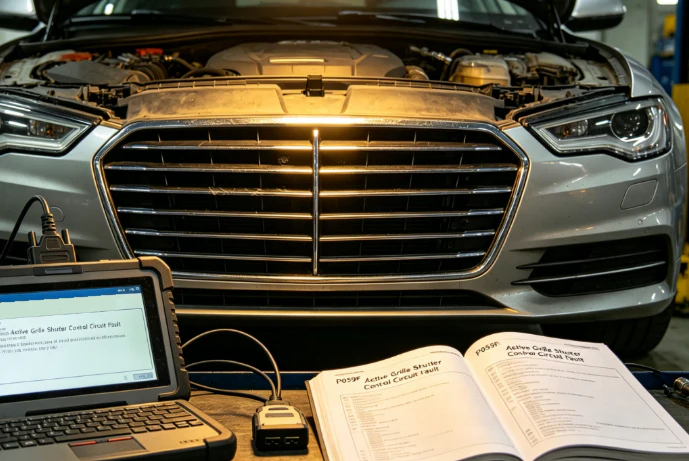
P059F Code Explained: Active Grille Shutter Stuck Off (Symptoms, Fix & Reset Guide)
Introduction: Modern Vehicular Aerodynamics and Thermal Regulation
In modern automotive engineering, thermal management systems have evolved far beyond the traditional mechanical thermostat and belt-driven radiator fan configuration. To meet stringent global emissions standards and optimize fuel efficiency profiles, vehicle manufacturers utilize active aerodynamic components. Foremost among these systems is the Active Grille Shutter (AGS) assembly, positioned directly at the vehicle’s front bumper facade.
When a malfunction occurs within this network, the Powertrain Control Module (PCM) or Engine Control Module (ECM) logs diagnostic trouble codes. This technical brief provides a comprehensive P059F code explained guide, detailing the mechanical operations, diagnostic profiles, and brand-specific failure patterns of this common automotive fault.
System Definition: Demystifying the P059F Fault Parameters
The P059F code is defined as an OBD-II generic powertrain fault signifying Active Grille Air Shutter “A” Performance / Stuck Off. In European markets, standard EOBD diagnostics log this exact fault under DTC P059F. When utilizing professional-grade diagnostic equipment, the fault may present with a specific symptom byte as P059F-00. The “-00” suffix indicates a General Failure with no further sub-type data, confirming a comprehensive system performance hang-up.
Understanding “Performance / Stuck Off” Mechanical Logic
-
Performance Parameter: The PCM continuously monitors the real-time feedback loop regulating shutter articulation. If the shutter fins move too slowly, draw excessive electrical current, or fail to achieve the commanded physical angles within a pre-calculated factory threshold, a performance error is flagged.
-
Stuck Off Definition: In standardized automotive control logic, “Off” defines the fully closed resting position of the shutter array. Therefore, “Stuck Off” specifies that the active grille shutters remain locked in a closed orientation, blocking dynamic airflow into the engine bay.
The Front Fascia Induction Loop: Structural Layout
To visualize how the active grille shutter controls incoming airflow before it interfaces with the vehicle’s primary cooling infrastructure, refer to the operational flow layout below:
[Dynamic Front Airflow] --> [ACTIVE GRILLE SHUTTERS] --> [A/C Condenser Core]
                                     |
              +----------------------+----------------------+
              | (Commanded Open)                            | (Commanded Closed / STUCK OFF)
              v                                             v
     [Radiator Core Input]                        [Air Diverted Around Body]
              |                                             |
              v                                             v
[Optimal Engine Thermal Balance]               [Reduced Aerodynamic Drag Profile]
When functioning normally, the system opens the shutters to provide direct cooling air to the radiator or closes them to reduce aerodynamic drag at highway speeds.
Symptom Analysis: Operational Red Flags
When the PCM flags a P059F code, technicians and owners should watch for several distinct operational symptoms affecting the vehicle’s cooling and efficiency loops.
1. Primary Indicators and Shutter Immobilization
The most immediate indicator is an illuminated Check Engine Light (CEL) on the instrument panel. Mechanically, the core symptom is an inoperative grille shutter assembly. While the system can occasionally fail in the open position, a “Stuck Off” status means the slats remain closed, physically restricting air intake.
2. Cooling System Irregularities and Fan Compensation
Because a closed shutter blocks ambient air from reaching the radiator core, engine cooling is heavily compromised. To prevent severe overheating, the ECM compensates by running the electric radiator cooling fans more frequently and at maximum high-speed velocity. Conversely, if the assembly experiences a failure that leaves the fins stuck open, the engine will suffer from slow warm-up times during cold weather operation.
3. Aerodynamic and Efficiency Degradation
Active shutters are designed to close at highway speeds to create a streamlined aerodynamic profile over the front end. If the system drops offline and stays stuck wide open, fuel economy drops slightly due to increased wind resistance across the front bumper structure.
Technical Root Causes: Why the AGS System Fails
The underlying causes of a P059F fault code typically fall into mechanical binding, electrical failures, or environmental factors.
                             [P059F FAULT ROOT CAUSES]
                                         |
      +------------------------+---------+------------------------+
      |                        |                                  |
[MECHANICAL FAILURES]    [ELECTRICAL FAILURES]          [ENVIRONMENTAL FACTORS]
  * Actuator Gear Wear     * Frayed Bumper Harness        * Ice & Snow Packing
  * Stripped Motor Teeth   * Terminal Corrosion           * Road Debris Blockage
  * Misaligned Fin Slat    * Sensor Feedback Dropout      * Front Impact Damage
-
Actuator Motor and Internal Gear Failure: The small electric actuator motor contains plastic drive gears that are highly prone to tooth stripping, internal binding, or motor winding burnout over long-term operation. This stands as the primary cause of P059F faults.
-
Physical Obstructions and Fin Misalignment: Due to its vulnerable placement at the front of the vehicle, the shutter grid frequently collects leaves, road grit, dirt, and winter ice accumulation. This debris physically jams the linkage. Minor front-end collisions can also bow or crack the plastic slats, limiting their full range of movement.
-
Harness Damage and Intermittent Electrical Signals: The wiring harness routed behind the front bumper assembly is constantly exposed to moisture, road salt, and debris vibration. This environment easily leads to corroded electrical connector pins, frayed wires, or poor ground contacts that disrupt sensor signals back to the PCM.
Step-by-Step Diagnostic Protocol
Diving straight into replacing parts without a structured diagnostic process can lead to wasted time and money on functional components. Follow this step-by-step procedure to isolate the root cause:
-
Perform an Initial OBD2 Scan: Connect a professional diagnostic scan tool to verify if code P059F is active or stored. Check for accompanying thermal management or cooling system trouble codes, and save the freeze-frame data to analyze vehicle speed, coolant temperature, and engine load at the moment the fault occurred.
-
Conduct a Thorough Visual Inspection: Check the front grille area for trapped debris, road grime, or ice. Inspect the individual plastic shutter fins to ensure none are bent, unclipped from their drive linkage, or cracked from a road impact.
-
Monitor the Cold Start Diagnostic Cycle: Start the vehicle from a cold state while observing the front grille. A healthy AGS system executes a automated self-test sweep upon startup, opening and closing the shutters fully to verify operational limits. Total lack of movement indicates an electrical dropout or a seized motor assembly.
-
Execute Bidirectional Active Command Tests: Using a scan tool with bidirectional control capability, access the AGS actuator test menu. Manually command the shutters to open 100% and close 0% while listening closely to the actuator motor. A loud clicking or straining sound points directly to stripped internal plastic gears, while complete silence indicates a dead motor or a broken power circuit.
Quick Resolution Matrix: Repair Actions
Once your diagnosis identifies the specific point of failure, match your findings to the correct service fix:
| Diagnostic Finding / Scenario | Target Component Repair Action | Technical Consideration / Note |
| Fins jammed by leaves, mud, or winter ice buildup |
Clean Debris & Obstructions |
Clear the blockage manually; check that the plastic linkage moves freely. |
| Green corrosion in harness plug; broken wires |
Repair Wiring & Connectors |
Clean the terminal pins with electrical contact cleaner or splice in a new pigtail. |
| Noisy, straining, or non-responsive actuator motor |
Replace Grille Shutter Actuator |
On many models, the actuator can be unbolted and replaced separately from the frame. |
| Cracked outer housing frame; broken shutter slats |
Replace Full AGS Assembly |
Requires removing the front bumper cover to swap out the entire structural assembly. |
How to Properly Reset and Verify Code P059F
Simply clearing the code will not provide a permanent fix unless the underlying mechanical or electrical fault is repaired first.
Resetting with a Diagnostic Tool (Preferred Route)
Connect your OBD2 scanner to the vehicle’s diagnostic port, navigate to the PCM/ECM module, and select the “Clear DTCs” option. This cleanly wipes the error code and turns off the Check Engine Light.
Manual Battery Disconnect Reset (Alternative Route)
If you do not have a scan tool available, turn the vehicle ignition completely off. Use a wrench to disconnect the negative (-) battery cable and leave it unhooked for 15 to 30 minutes to drain the capacitors and reset the ECM’s volatile memory. Reconnect and tighten the terminal securely.
Post-Reset Verification Procedure
After resetting, execute a complete drive cycle to confirm the fix. Perform a cold startup to verify the automated shutter sweep, then take the vehicle on a short road test that includes both stop-and-go city driving and highway speeds. Re-scan the module to ensure P059F does not return as a pending code.
Brand-Specific Behavior: GM, Nissan, and Ford Platforms
The P059F fault code can behave differently across various major auto manufacturers, with distinct failure trends and even different code names for the same issue.
-
Chevrolet Silverado & GMC Sierra (2017–2019): These full-size trucks are highly prone to mechanical jamming from road grit and winter ice build-up due to their front-end styling. Fortunately, the actuator motor on these GM trucks can be replaced separately, meaning you rarely need to buy a complete, expensive shutter frame assembly.
-
Nissan Altima (2016 / 2019): Nissan models frequently encounter electrical communication dropouts rather than pure mechanical failures. The fault on these vehicles is often tracked down to corroded connector plug terminals or software logic deviations that require a system reset and an electronic idle relearn procedure.
-
Ford F-150 & Ford Edge: Ford platforms share the exact same active thermal management design logic but utilize a manufacturer-specific code profile. A Ford vehicle will rarely trigger code P059F; instead, it logs code P05A1 (Active Grille Air Shutter “A” Performance / Stuck Off). The diagnostic steps, component layouts, and repair methods remain identical.
Schimbarea neautorizată a motorului: pericol, dovezi, soluții
Driving Risks and Safety Assessment
Can you safely drive with a active P059F code? Yes, for short periods, but the overall risk level depends heavily on the position the shutters fail in. If the shutters fail stuck open, the risk to your engine is low, resulting only in slightly reduced fuel economy and longer heater warm-up times in the winter.
⚠️ WARNING: If the active grille shutters fail in the closed position (Stuck Off), driving long distances or under heavy loads creates a severe risk of engine overheating. If your coolant temperature gauge climbs into the red zone, or if you receive dashboard warnings about high engine temps, pull over immediately to prevent blowing a head gasket or causing permanent engine block distortion.
If you find yourself facing an electrical malfunction you cannot solve with a scan tool, or if replacing the full shutter frame requires removing the entire front bumper, consult a professional technician to ensure the active aerodynamic components are properly aligned and calibrated.
✍️ Author: Bejenaru Alexandru Ionut – [email protected]
🔗 Internal link: https://diagnozabam.ro/sfaturi

Recommendation: Looking for a professional bi-directional diagnostic tool with full system coverage? Use code DIAGNOZABAM for 10% off.
Transparency note: Affiliate link. Purchasing through it costs you nothing extra. View Thinkcar Deal →