
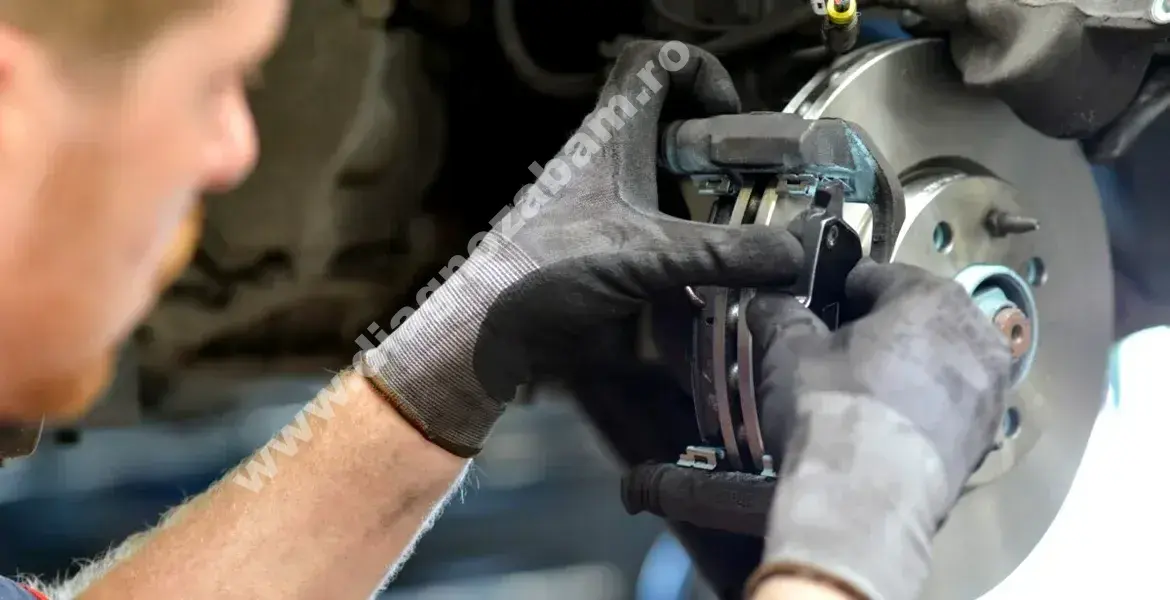
When to Replace Brake Pads and Rotors: Signs, Limits and Checks
Replace brake pads when the friction material drops to about 3 mm. Replace rotors when they fall below the minimum thickness stamped on them, or when they show deep grooves, cracks or heavy warping. Most cars give clear warnings before this point. You only need to know what to look for.
Pads wear out faster than rotors. Many rotors last through two sets of pads. But a worn pad can damage a rotor in a few weeks. That is why timing matters.
How a Disc Brake Wears
A disc brake has three main parts. The pad is the friction material. The rotor is the steel disc that spins with the wheel. The caliper squeezes the pad against the rotor.
Each time you brake, a little pad material wears away. A little rotor material goes too, but much more slowly.
        ROTOR (spins with wheel)
           |
   PAD --> |<-- PAD
   (friction material + steel backing plate)
           ^
        CALIPER squeezes both pads
The pad has two layers. The friction layer touches the rotor. The steel backing plate holds it. When the friction layer is almost gone, the backing plate can touch the rotor. That causes metal-on-metal damage.
ℹ️ Technical Note: New pads usually start with 10 to 12 mm of friction material. The exact figure varies by car and pad type. Check the spec for your model if you want a precise number.
How Long Do Brake Pads Last
There is no fixed mileage. Pad life depends on how you drive, where you drive and what the car weighs.
| Condition | Typical pad life |
|---|---|
| Mostly highway driving | 60,000 – 100,000 km |
| Mixed driving | 40,000 – 70,000 km |
| Heavy city traffic | 25,000 – 45,000 km |
| Towing or hilly roads | 20,000 – 40,000 km |
| Aggressive driving | Often under 30,000 km |
Front pads wear faster than rear pads. The front brakes do most of the stopping. Expect the front set to need replacing first, often twice as often as the rear.
Electric and hybrid cars can wear pads very slowly. Regenerative braking does much of the work. But pads on these cars can rust or seize from lack of use. Inspect them by age, not only by mileage.
7 Signs Your Brake Pads Need Replacing
1. A high-pitched squeal
Many pads have a small metal tab called a wear indicator. When the pad gets thin, the tab touches the rotor. It makes a squeal on purpose. This is a warning, not a fault.
Not every squeal means worn pads. Dust, moisture and glazed pads can also squeal. But a steady squeal while driving, which stops when you press the pedal, often points to the indicator.
2. A grinding noise
Grinding is a late warning. It usually means the friction material is gone. The backing plate is now scraping the rotor.
Stop driving if you hear it. Every extra kilometre cuts into the rotor. A pad job can turn into a pad and rotor job.
3. The brake warning light
Some cars have electronic wear sensors in the pads. When the pad gets thin, the sensor wire wears through. The dashboard shows a brake pad warning.
Do not ignore the light. After you replace the pads, the sensor also needs replacing. Some cars need the warning reset with a scan tool.
4. A longer stopping distance
If the car takes longer to stop, the pads may be thin or glazed. Heat can harden the surface, which cuts friction. Check this early. It is a safety issue.
5. Vibration in the pedal or steering wheel
A pulsing pedal usually points to a rotor problem, not the pads. Uneven rotor thickness or deposits on the surface create the pulse. The steering wheel may shake when you brake from speed.
6. The car pulls to one side
A car that pulls when braking has uneven braking force. A stuck caliper, a seized slide pin or a worn pad on one side can cause it. Inspect both sides on the same axle.
7. Visible wear
You can often check the pads without removing the wheel. Look through the gaps in the wheel spokes. You should see the pad pressed against the rotor.
If the friction layer looks thinner than the steel backing plate, replace the pads. For an exact reading, remove the wheel and measure.
⚠️ WARNING: Do not rely on one sign. A pad can be dangerously thin without any noise. Inspect the pads at least once a year, or at every tire rotation.
How to Check Pad Thickness
You need a jack, jack stands, a wheel wrench and a ruler or caliper gauge.
- Park on level ground and apply the parking brake. On cars with an electric parking brake, release it only if the manual allows this.
- Loosen the wheel nuts slightly.
- Lift the car and support it on jack stands. Never work under a car on a jack alone.
- Remove the wheel.
- Look at the pad from the side. Measure the friction material only, not the steel plate.
- Check both pads in the caliper. The inner pad often wears faster.
- Compare the left and right sides.
What the numbers mean
| Friction material left | What to do |
|---|---|
| Over 6 mm | Good. Recheck at the next service |
| 4 – 6 mm | Plan a replacement soon |
| 3 – 4 mm | Replace now |
| Under 3 mm | Do not drive far. Replace immediately |
Uneven wear is a warning on its own. If one pad is much thinner than the other, the caliper or the slide pins may be sticking.
When to Replace Rotors
Rotors wear slowly, but they do wear. Pads and rotors are a matched system. A new pad on a bad rotor wears fast and brakes poorly.
Minimum thickness
Most rotors have a minimum thickness stamped on the edge or hat. It may read “MIN TH” followed by a number in millimetres. This is the lowest safe value.
Measure the rotor with a micrometer at several points. If any reading is at or below the stamped limit, replace the rotor. A rotor thinner than the limit overheats and can crack.
Visual checks
Replace or resurface a rotor if you find:
- Deep grooves you can catch with a fingernail.
- A raised lip at the outer edge from wear.
- Cracks, especially around the holes of drilled rotors.
- Blue or dark spots from overheating.
- Heavy rust on the braking surface after long storage. Light surface rust clears after a few stops.
Pulsation
If the pedal pulses and the rotor looks fine, measure the thickness at several points around the disc. Variation over the manufacturer’s limit means the rotor needs resurfacing or replacement.
ℹ️ Technical Note: Resurfacing removes material. It only works if the rotor stays above its minimum thickness afterwards. On thin modern rotors, replacement is often the better choice.
Pads Only or Pads and Rotors?
This is the question that costs people money.
| Situation | Best option |
|---|---|
| Rotor smooth, above minimum thickness | Pads only |
| Light grooves, rotor above minimum | Pads only, or resurface |
| Deep grooves or a raised lip | Replace rotors |
| Rotor at or below minimum | Replace rotors |
| Pulsation with uneven thickness | Resurface or replace |
| Pads ground to the backing plate | Replace both |
Always replace rotors in pairs, on the same axle. Always replace pads in pairs too. Mixing a new rotor with an old one gives uneven braking.
Why Pads Wear Unevenly
Even wear is normal. Uneven wear points to a fault. Check for:
- Seized slide pins. The caliper cannot float, so one pad drags.
- A sticking piston. The pad stays pressed after you release the pedal.
- A collapsed brake hose. It holds pressure in the caliper.
- Missing or damaged hardware clips. They help the pad move freely.
If you replace pads without fixing the cause, the new set wears out fast. Clean and lubricate the slide pins every time. Use brake grease made for the job.
Electric Parking Brake: A Step Many Skip
Many modern cars have an electric parking brake. The rear caliper has a small motor. You cannot simply push the piston back with a clamp. This can damage the motor and the mechanism.
Before you work on the rear brakes, put the system into service mode. A bidirectional scan tool can do this on many cars. The tool retracts the piston electrically. After the job, it recalibrates the system.
A tool like the THINKCAR THINKSCAN 689BT can run this kind of function on supported models. Always check coverage for your exact car before you start.
Without service mode, the system may report faults. Or the new pads may sit too close to the rotor and drag.
Bedding In New Pads
New pads need a short break-in. It makes the pad and rotor surfaces match.
- Drive to a quiet road with no traffic behind you.
- Brake gently from about 50 km/h down to 10 km/h. Do not stop fully.
- Repeat 8 to 10 times, with short gaps.
- Drive for a few minutes without braking hard, so the brakes cool.
- Avoid hard stops for the first 200 km.
Do not hold the car at a standstill with the brakes pressed hard right after a heavy bedding session. Hot pads can leave a pattern on the rotor.
Common Mistakes
- Changing pads without checking the rotor. A worn rotor ruins new pads.
- Skipping the slide pins. Dry pins cause uneven wear.
- Using the wrong pad type. Match the pads to the car and the way you drive.
- Pushing the piston back hard and damaging the seal or the electric mechanism.
- Forgetting to pump the pedal after the job. The pedal goes to the floor until the pads touch the rotor again.
- Greasing the wrong surface. Grease on the pad face or rotor surface kills braking power.
- Not retorquing the wheel nuts to the correct value.
How Much Does It Cost
Prices vary by country and car. As a general guide:
- Pads cost far less than rotors.
- Doing pads only is cheapest. Pads plus rotors costs more, but it usually gives better braking and longer life.
- Premium and ceramic pads cost more and often last longer with less dust.
A cheap pad on a worn rotor can cost you more in the end. If the rotor is borderline, replace it at the same time.
FAQ
When should I replace brake pads?
Replace them when the friction material drops to about 3 mm. Also replace them if you hear grinding, see a brake warning light or notice longer stopping distances.
How many kilometres do brake pads last?
Between 25,000 and 100,000 km, depending on driving style and conditions. City driving and towing wear them faster. Highway driving wears them slower.
Do I need to replace rotors every time I replace pads?
No. Replace rotors only if they are worn below the minimum thickness, deeply grooved, cracked or badly warped. Smooth rotors above the limit can often take new pads.
Is a squealing noise always a sign of worn pads?
No. Dust, moisture and glazed pads can squeal too. But a steady squeal that stops when you press the pedal often comes from the wear indicator.
Can I drive with grinding brakes?
You should not. Grinding usually means metal is touching metal. It damages the rotor fast and reduces braking power. Get it fixed right away.
Why does my brake pedal pulse?
Usually the rotor has uneven thickness or surface deposits. Measure the rotor and replace or resurface it if it is out of limit.
Why do the pads on one side wear faster?
A seized slide pin, a sticking piston or a collapsed hose are common causes. Inspect the caliper on the worn side.
Do I need a scan tool to change rear pads?
On cars with an electric parking brake, yes, in most cases. The scan tool puts the caliper into service mode. Without it you risk damaging the mechanism.
Do electric cars need new pads less often?
Often yes, because of regenerative braking. But pads can still rust or seize with age. Inspect them at least once a year.
Should I replace pads and rotors in pairs?
Yes. Always replace both sides of the same axle together. Different wear levels left and right cause pulling and uneven braking.
✍️ Author: Bejenaru Alexandru Ionut – [email protected]

Recommendation: Looking for a professional bi-directional diagnostic tool with full system coverage? Use code DIAGNOZABAM for 10% off.
Transparency note: Affiliate link. Purchasing through it costs you nothing extra. View Thinkcar Deal →