
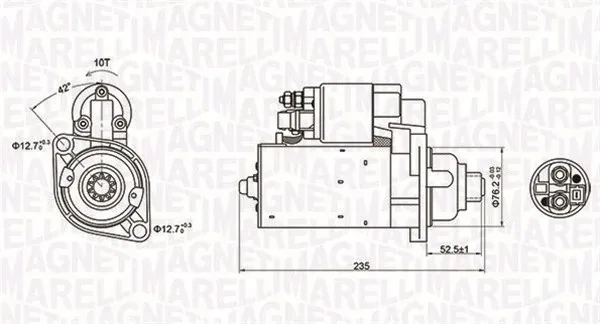
Failed Starter Motor: Early Symptoms, Internal Mechanics, and Modern Diagnostic Solutions
It was a cold November morning. The headlights worked and the battery was fine, but when the driver turned the key — just a click. Silence followed. In the garage, the mechanic smiled:
“It’s the starter motor. It always betrays you first, right when you need the car the most.”
The starter motor converts electrical energy into rotational mechanical motion. It spins the engine for just a few seconds to initiate the combustion cycle. Inside, every component — the carbon brushes, solenoid, rotor, and stator — must work in perfect rhythm under a high-current load.
How a Starter Motor Works Under Starting Load
To understand why a failure occurs, we must analyze the energy flow during startup:
[Key / Start Button] ➔ [Relay Signal] ➔ [Solenoid / Engagement Relay] ➔ [Bendix Engagement] ➔ [Rotor & Engine Spin]
-
Solenoid Engagement: Upon receiving the start signal, the solenoid receives power. It mechanically pushes the bendix pinion onto the flywheel ring gear while closing the high-current internal electrical contacts.
-
High-Current Transfer: These contacts allow a massive current (typically 150 to 400 Amperes) to flow directly from the battery to the carbon brushes and rotor.
-
Cranking and Release: The rotor spins rapidly, turning the flywheel. Once the engine starts, the key is released. An overrunning clutch protects the starter motor from overspeeding, and the solenoid retracts the pinion.
Early Symptoms of a Failing Starter Motor
Before it dies completely, the starter motor gives clear warning signs:
-
Slow Cranking: The engine turns over hesitantly, even if the battery measures over 12.6V at rest. Worn bushings or carbon brushes are usually the main cause.
-
Single Click Without Cranking: The solenoid pushes the bendix pinion, but internal electrical contacts are oxidized or the worn carbon brushes fail to touch the commutator.
-
Faint Burning Smell: This indicates thermal overloading in the internal windings.
-
Intermittent Failure: The starter works fine one day, but fails to turn over the next.
What the Mechanic Found in the Shop
The mechanic removed the starter motor from the vehicle and disassembled it. The root cause was clear: the carbon brushes were almost completely worn down.
[Brush Wear] ➔ [Poor Contact] ➔ [Electrical Arcing & Heat] ➔ [Voltage Drop] ➔ [Total Failure]
The spring levers could no longer press the brushes against the commutator. One inexpensive part subject to constant friction held back an entire engine.
Electronic Diagnostics with ThinkCar ThinkScan 689BT
On modern vehicles, the starting procedure is controlled by electronic modules such as the BCM or ECU. Before removing hardware, a computer scan rules out immobilizer or relay issues.
The ThinkCar ThinkScan 689BT scanner provides full diagnostic capabilities for starting and electrical systems.
[OBD2 Port] ➔ [ThinkScan 689BT Bluetooth] ➔ [ECU/BCM Module Scan] ➔ [Voltage & Relay Check]
Useful Features for Starting System Diagnostics:
-
Real-time Voltage Monitoring: Using the ThinkCar ThinkScan 689BT, you can track voltage drops during cranking. A drop below 9.5V signals a weak battery or an internal short circuit in the starter.
-
DTC Reading: The ThinkCar ThinkScan 689BT identifies starter relay circuit faults or immobilizer issues.
-
Active Tests: You can trigger the starter relay directly through the ThinkCar ThinkScan 689BT interface to test the signal path to the solenoid.
Comparison: Symptoms and Likely Causes
| Observed Symptom | Probable Cause | Diagnostic Method |
| Single click, no engine cranking | Bad solenoid or worn brushes | Direct power test / Scan with ThinkCar ThinkScan 689BT |
| Very slow cranking with good battery | Worn bushings or stuck brushes | Voltage drop test under load |
| Whining sound without engine rotation | Failed bendix clutch or worn teeth | Mechanical inspection of bendix & flywheel |
| Complete silence, no reaction | Blown fuse, bad relay, active immobilizer | Active relay testing with ThinkCar ThinkScan 689BT |
Practical Maintenance Pro Tips
-
Don’t ignore slow cranking: If the engine turns slowly, inspect the starter motor even if the battery tests well.
-
Clean grounds and terminals: Corrosion on ground cables creates high electrical resistance, mimicking a dead starter.
-
Keep connections dry: Oil leaks onto the starter dissolve carbon brushes and shorten component life.
-
Inspect the starter at 100,000 km: Cleaning the commutator and replacing carbon brushes prevents unexpected breakdowns.
-
Perform regular scans: Using a tool like ThinkCar ThinkScan 689BT helps detect stored intermittent faults early.
Conclusion
The starter motor is your car’s heartbeat before ignition — a silent mechanism full of secrets. Recognizing early warning signs and using modern scan tools like the ThinkCar ThinkScan 689BT will keep you from being stranded on a cold morning.
✍️ Author: Bejenaru Alexandru Ionut – [email protected]
🔗 Internal link: https://diagnozabam.ro/sfaturi

Recommendation: Looking for a professional bi-directional diagnostic tool with full system coverage? Use code DIAGNOZABAM for 10% off.
Transparency note: Affiliate link. Purchasing through it costs you nothing extra. View Thinkcar Deal →
