
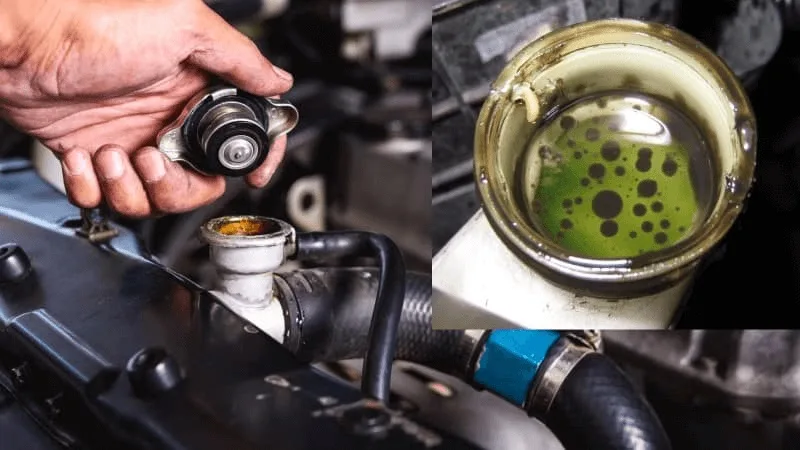
The presence of oil in the coolant expansion tank is never a good sign. Most drivers discover this issue while checking the coolant level in their vehicle’s liquid cooling system. In this article, we’ll go through the main symptoms, causes, and risks associated with oil contamination in the coolant tank — and how to test it correctly.
Table of Contents
-
Signs of oil in the coolant expansion tank
-
How to test for oil in coolant
-
Common defects that lead to oil entering coolant
-
Causes of oil leakage into the cooling system
-
Consequences of oil mixing with antifreeze
-
Final conclusions
1. Signs of Oil in the Coolant Expansion Tank
If you notice any of the following symptoms, it’s likely that oil has entered your coolant:
-
A greasy emulsion on the filler neck or walls of the expansion tank (a creamy mix of oil and coolant).
-
A dark, rainbow-colored film floating on the surface of the coolant.
-
Change in coolant color or consistency — clean coolant should be clear blue, green, yellow, or red.
-
Unusual smell — coolant usually has a faint sweet odor, but when mixed with oil, it develops a sharp, burnt smell.
-
Oily texture when touched — normal coolant is never greasy.
-
Frequent engine overheating — oil reduces the cooling efficiency, causing the engine to heat up faster.
-
Oil stains inside the expansion tank or on the radiator cap.
-
Foaming or bubbles in the expansion tank when the engine runs — a clear sign of pressure leakage.
If several of these symptoms appear, the diagnosis is certain: there’s oil in your coolant.
2. How to Test for Oil in Coolant
If you suspect oil contamination but aren’t sure, you can perform a simple test:
-
Take a clean, dry tissue or paper towel and dip it into the coolant expansion tank.
-
Remove it quickly and light it on fire.
-
If it burns, there is oil present (since coolant itself does not ignite).
-
If it doesn’t burn, it’s only coolant — no oil contamination detected.
-
If oil is indeed present, it means that a seal has failed, and the system must be checked thoroughly. Ignoring it can lead to radiator clogging, engine overheating, and even engine failure.
3. Defects That Cause Oil to Enter the Coolant
| No. | Symptom | How to Check |
|---|---|---|
| 1 | Change in coolant color and consistency | Visual inspection or tissue test |
| 2 | Oil film on coolant surface | Check expansion tank and radiator cap |
| 3 | Coolant smells like oil | Smell test |
| 4 | Frequent overheating | Check coolant level, replace fluid, clean system |
| 5 | Air bubbles in expansion tank | Indicates depressurization or gasket failure |
4. Causes of Oil Leakage into Coolant
Oil may enter the cooling system due to several reasons, ranging from minor to serious:
-
Blown head gasket (the most common cause)
-
Worn or damaged oil cooler (heat exchanger)
-
Cracked cylinder wall or liner
Repair Methods:
-
Replace the head gasket and tighten bolts to the manufacturer’s torque using a torque wrench.
-
Resurface the cylinder head at a professional auto service.
-
Replace the oil cooler if it’s leaking (repairs are rarely successful long-term).
-
In severe cases, rebuild or replace the engine block.
5. Consequences of Oil Mixing with Coolant
Many drivers wonder if it’s still safe to drive when oil gets into the coolant. The answer depends on the amount of oil present.
If it’s a small quantity, you might drive a short distance — ideally straight to a repair shop. However, continued use can cause serious engine damage.
Oil contamination reduces the coolant’s efficiency and can lead to:
-
Repeated engine overheating
-
Clogging of the radiator and cooling passages
-
Corrosion and damage to cooling components
-
Severe engine wear due to reduced lubrication (especially if coolant enters the oil as well)
When both fluids mix in both directions (oil in coolant and coolant in oil), the engine’s lubrication drastically decreases — leading to partial or total engine failure.
6. Conclusion
Driving a car with oil in the coolant expansion tank is acceptable only in emergencies — for example, to reach a nearby service. Immediate inspection and repair are essential to prevent costly damage.
Neglecting this issue will eventually lead to major engine repair costs and irreversible damage to the cooling system.
✍️ Author: Bejenaru Alexandru Ionut – [email protected]
✍️ Author: Bejenaru Alexandru Ionut – [email protected]
🔗 Internal link: https://diagnozabam.ro/sfaturi

Recommendation: Looking for a professional bi-directional diagnostic tool with full system coverage? Use code DIAGNOZABAM for 10% off.
Transparency note: Affiliate link. Purchasing through it costs you nothing extra. View Thinkcar Deal →
