
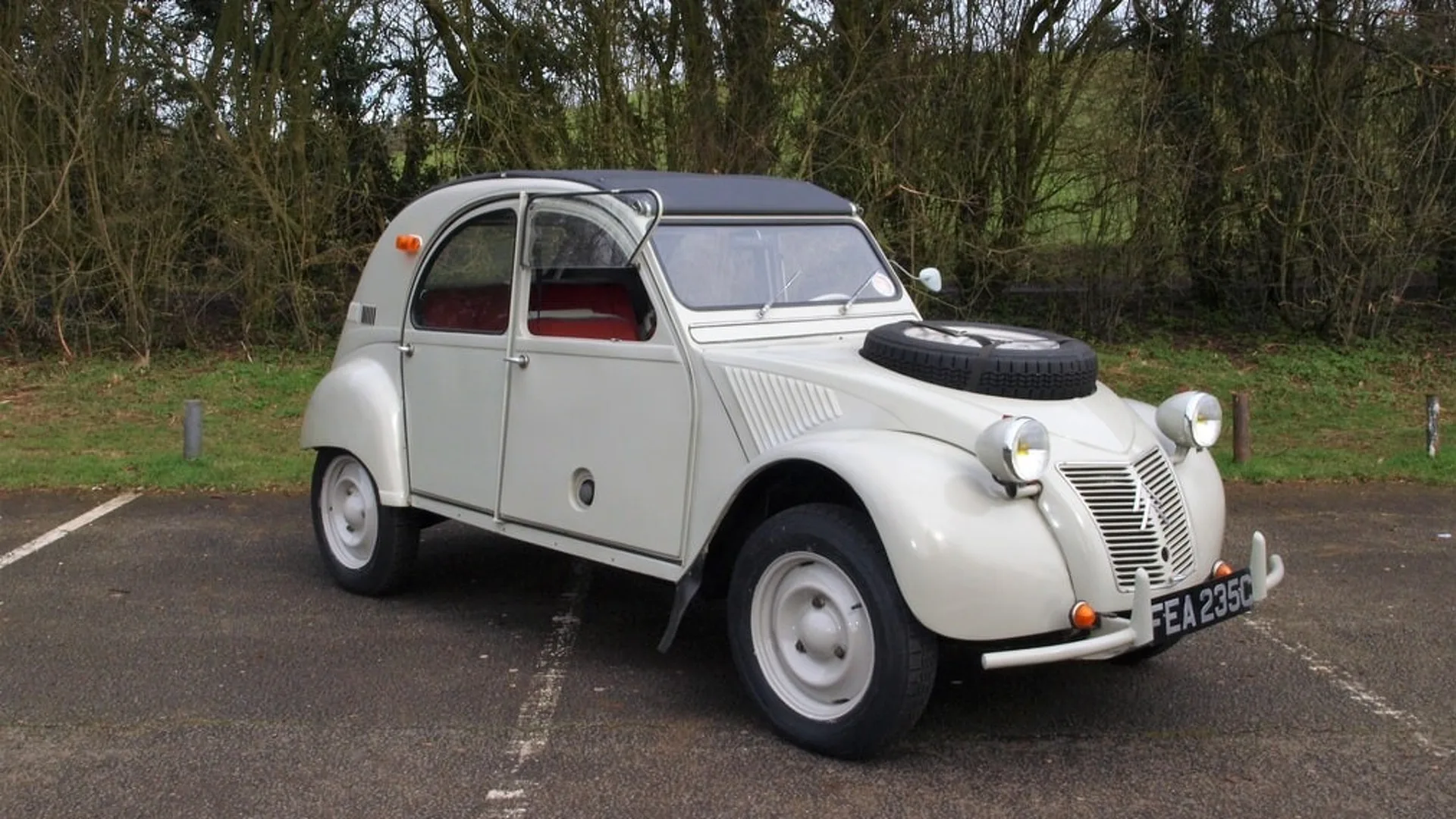
Citroën 2CV Sahara: The Car With Two Engines
Most four-wheel-drive systems rely on a single engine sending power to all four wheels through a transfer case, differentials, and driveshafts. Citroën took a radically different approach in 1958, and the result was one of the strangest — and most ingenious — production vehicles ever built: a car with two completely independent engines, one at each end.
What Made the 2CV Sahara Different
The Citroën 2CV Sahara is a special off-road variant of the iconic 2CV, produced between 1960 and 1971 specifically to handle the harshest terrain imaginable — from the dunes of North Africa to remote, roadless mountain regions where conventional vehicles simply couldn’t go.
Instead of engineering a complex transfer case and driveshaft system to split power from a single engine across both axles — the standard approach to four-wheel drive — Citroën’s engineers did something almost absurdly simple: they fitted two complete, independent engines, one under the front hood driving the front wheels, and one in the rear trunk driving the rear wheels.
ℹ️ Technical Note: This layout meant the 2CV Sahara had no center differential, no transfer case, and no shared drivetrain components between the front and rear axles at all. Each end of the car was mechanically self-sufficient — an engineering approach almost never seen before or since in a production vehicle.
How the Twin-Engine System Worked
[Front Engine — 425cc, 12 HP]
         |
         v
[Front Gearbox + Clutch] → [Front Axle / Front Wheels]


[Rear Engine — 425cc, 12 HP]
         |
         v
[Rear Gearbox + Clutch] → [Rear Axle / Rear Wheels]

(No mechanical connection between front and rear systems)
Each engine had its own dedicated gearbox and clutch, fully independent of the other. The driver could choose to run the car on either engine alone, or engage both simultaneously for maximum traction in difficult terrain.
Core technical specifications:
- Two 425 cm³ air-cooled engines, 12 HP each — 24 HP combined
- Two separate gearboxes and two separate clutches
- Capable of running on a single engine (front or rear) or both together
- Top speed: approximately 65 km/h with both engines engaged
⚠️ WARNING: The combined output of 24 HP sounds modest by any modern standard, but the design priority was never speed — it was reliability and traction in conditions where getting stuck meant being stranded with no help for days.
The Redundancy Advantage
The cleverest part of the design wasn’t the four-wheel-drive capability itself — it was what happened when something went wrong. If one of the two engines failed in the middle of the desert or a remote mountain pass, the car wasn’t stranded. It could simply continue running on the surviving engine, front or rear, and limp back to civilization under its own power.
This single feature made the 2CV Sahara extraordinarily valuable to the people who actually bought and used it: military units, police forces operating in remote regions, doctors making rounds in inaccessible areas, and engineers working on infrastructure projects far from any service station. For these users, a vehicle that could fail halfway and still get you home wasn’t a luxury — it was the entire point.
ℹ️ Technical Note: Both engines could be started and controlled independently from the driver’s seat, with separate ignition and throttle linkages routed to a single set of controls. Despite running two engines, the driving experience from inside the cabin remained relatively straightforward for the era.
Production Numbers and Rarity Today
Only around 694 units of the Citroën 2CV Sahara were ever produced between 1960 and 1971. This makes it one of the rarest production Citroëns in existence, and the rarity has translated directly into significant collector value.
| Detail | Figure |
|---|---|
| Production years | 1960–1971 |
| Total units produced | ~694 |
| Engine configuration | 2× 425cc, 12 HP each |
| Combined output | 24 HP |
| Top speed | ~65 km/h |
| Auction value (well-preserved examples) | €100,000+ |
Surviving examples that come up at classic car auctions routinely sell for over €100,000 — a striking figure for a car whose base specification, the standard 2CV, was designed and priced as one of the most affordable, no-frills vehicles in postwar Europe.
⚠️ WARNING: Because so few were built and even fewer survive in original, unmodified condition, authentication matters enormously at this price point. Buyers should verify chassis numbers and engine provenance carefully before any purchase — replica and modified 2CVs dressed up as Saharas do circulate in the classic car market.
Why the 2CV Sahara Still Matters
The Citroën 2CV Sahara proved a concept that seemed almost too simple to work: genuine four-wheel-drive capability could be achieved without a transfer case, a center differential, or any shared drivetrain hardware at all — just two complete, independent powertrains working in parallel.
Some automotive historians go further, arguing that the 2CV Sahara deserves recognition as the first true SUV — a vehicle purpose-built to combine everyday road usability with genuine off-road and rough-terrain capability, decades before the term “SUV” existed and long before vehicles like the original Range Rover (launched in 1970) popularized the concept for a mainstream audience.
Whether or not it earns that specific title, the Sahara remains a singular engineering statement: proof that sometimes the most elegant solution to a complex problem is simply doing the obvious thing twice.
Conclusion
The Citroën 2CV Sahara stands as one of the most unconventional production vehicles in automotive history — not because of raw performance or luxury, but because of the sheer ingenuity of its twin-engine, twin-drivetrain solution to all-terrain capability. With fewer than 700 units ever built, it has become a six-figure collector’s item, but its real legacy is conceptual: it showed that redundancy and simplicity, applied cleverly, could outperform complexity in the conditions that mattered most.
✍️ Author: Bejenaru Alexandru Ionut – [email protected]
🔗 Internal link: https://diagnozabam.ro/sfaturi

Recommendation: Looking for a professional bi-directional diagnostic tool with full system coverage? Use code DIAGNOZABAM for 10% off.
Transparency note: Affiliate link. Purchasing through it costs you nothing extra. View Thinkcar Deal →
