
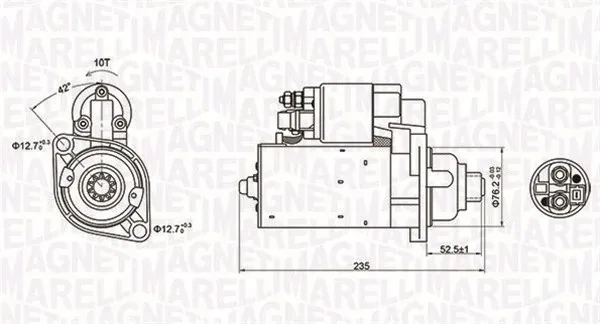
Car Starter Motor Failure Symptoms: The Complete Diagnostic Guide
You turn the key. Nothing happens. Or worse — you hear a single click and silence.
Your battery tests fine. Your lights work. So what’s going on?
Car starter motor failure symptoms often get misdiagnosed as battery problems, wasting time and money on the wrong fix. This guide breaks down exactly how a starter motor works, what failure actually sounds and feels like, and how to fix it.
How a Starter Motor Actually Works
Before diagnosing a failure, it helps to understand what’s supposed to happen.
When you turn the ignition key or press the start button, a sequence of electrical and mechanical events unfolds in under a second:
- Current flows from the battery to the starter solenoid.
- The solenoid engages, pushing the pinion gear forward.
- The pinion gear meshes with the flywheel teeth.
- The starter motor spins, rotating the engine’s crankshaft.
- The engine reaches ignition speed and combustion begins.
BATTERY
   |
[Ignition Switch]
   |
[Starter Solenoid] ---> [Pinion Gear Extends]
   |                            |
[Starter Motor Spins]    [Meshes with Flywheel]
   |                            |
[Crankshaft Rotates]  <---------|
   |
[Engine Starts]
ℹ️ Technical Note: The pinion gear only engages the flywheel for the brief moment needed to start the engine. Once the engine fires, a one-way clutch in the pinion prevents it from being driven backward at high RPM, which would destroy the starter.
This entire chain depends on multiple components working together. A failure at any point produces a different symptom — which is why accurate diagnosis matters.
Symptom 1: No Engine Crank, But Battery Is Good
This is the most common — and most confusing — scenario. You’ve tested the battery. Voltage is fine. But the engine simply won’t turn over.
What you’ll hear: A single loud click, or a rapid series of clicks, when you turn the key.
- A single click usually points to a failed solenoid that isn’t sending power through to the motor windings.
- Rapid clicking often indicates insufficient voltage reaching the solenoid — which can still be a connection issue even with a technically “good” battery.
⚠️ WARNING: A battery that tests good on a static voltage check can still fail under load. Always perform a load test before ruling out the battery entirely.
Symptom 2: Grinding Noises
A harsh, metallic grinding sound during startup is one of the clearest starter motor failure symptoms — and one of the most damaging if ignored.
This happens when the pinion gear fails to mesh properly with the flywheel teeth. Instead of smoothly engaging, the gears clash against each other.
Common causes:
- Worn or chipped pinion gear teeth.
- Worn flywheel teeth (damage can go both directions).
- Weak solenoid engagement, causing partial gear contact.
- Misaligned starter motor mounting.
⚠️ WARNING: Continuing to start the engine with a grinding starter accelerates flywheel damage. In severe cases, this turns a starter motor replacement into a much more expensive flywheel replacement.
Symptom 3: Slow or Delayed Cranking
The engine eventually turns over, but sluggishly — almost like it’s fighting against something.
This symptom is tricky because it mimics a weak battery almost perfectly. The difference lies in consistency:
| Cause | Behavior Pattern |
|---|---|
| Weak battery | Slow cranking worsens in cold weather, improves after charging |
| Failing starter motor | Slow cranking persists even with a fully charged battery |
| Worn starter brushes | Cranking speed gradually decreases over weeks or months |
Internally, this points to worn carbon brushes inside the starter motor, which reduce the electrical contact needed for full power delivery to the motor windings.
Symptom 4: Burning Smell or Smoke
If you notice an acrid, burning smell after attempting to start the car — especially combined with visible smoke near the engine bay — stop immediately.
This symptom indicates:
- Overheating from prolonged cranking attempts.
- Internal short circuits in the starter motor windings.
- Burnt windings, often from repeated failed start attempts putting excess strain on the motor.
⚠️ WARNING: A burning smell from the starter area is a fire risk indicator. Disconnect the battery and have the vehicle inspected before attempting to start it again.
Symptom 5: Intermittent Starting
Perhaps the most frustrating symptom on this list: the car starts fine most of the time, then randomly fails.
This inconsistency almost always traces back to one of two components:
- Worn brushes – contact becomes unreliable as brush material wears down unevenly, causing intermittent electrical connection.
- Faulty solenoid – internal contacts degrade over time, sometimes making a solid connection and sometimes not.
ℹ️ Technical Note: Intermittent electrical faults are notoriously difficult to diagnose because the problem may not be present when the car is tested at a workshop. A logged pattern of failures (time of day, engine temperature, weather) helps technicians narrow down the cause faster.
Common Causes Behind Starter Motor Failure
Summarizing the root causes across all five symptoms:
- Worn brushes – natural wear from friction over the starter motor’s lifespan.
- Damaged solenoid – internal contact points degrade with repeated use.
- Burnt windings – caused by overheating, often from repeated failed start attempts.
- Faulty bendix gear – the mechanism responsible for engaging and disengaging the pinion gear.
- Worn flywheel teeth – damage that can originate from the starter but affects a separate component entirely.
Diagnostic Comparison Table
| Symptom | Most Likely Cause | Urgency Level |
|---|---|---|
| No crank, single click | Faulty solenoid | High |
| No crank, rapid clicking | Weak connection or voltage drop | High |
| Grinding noise | Bad pinion/flywheel mesh | Critical |
| Slow cranking | Worn brushes | Medium |
| Burning smell/smoke | Overheating, burnt windings | Critical — stop immediately |
| Intermittent starting | Worn brushes or failing solenoid | Medium |
Solutions: What to Do Next
Step 1: Check Battery and Ground Connections First
Before assuming the starter motor itself has failed, rule out the simpler causes:
- Test battery voltage under load, not just at rest.
- Inspect battery terminals for corrosion.
- Check the ground strap connection between the engine and chassis — a weak ground is often mistaken for a starter failure.
Step 2: Test the Starter Motor at a Workshop
A bench test can confirm whether the starter motor draws correct current and produces adequate rotational force. This isolates the problem definitively, rather than guessing based on symptoms alone.
Step 3: Replace Brushes or Bendix Gear if Possible
On many starter motors, brushes and the bendix gear are replaceable components, rather than requiring a full unit swap. This is significantly cheaper when the rest of the motor is in good condition.
Step 4: Replace the Starter Motor Entirely
For severe damage — burnt windings, cracked housing, or extensive internal wear — a full starter motor replacement is the only reliable fix.
ℹ️ Technical Note: Rebuilt or remanufactured starter motors are often available at a lower cost than new units, offering a middle-ground solution for drivers on a budget.
Frequently Asked Questions
Can a bad starter motor drain the battery?
Not directly, but a starter drawing excessive current due to internal faults can strain the electrical system and contribute to battery stress over repeated start attempts.
Is it safe to keep driving with intermittent starting problems?
It’s risky. An intermittent fault can become a complete failure without warning, potentially leaving you stranded.
How long does a starter motor typically last?
Most starter motors last well over 100,000 kilometers under normal use, though frequent short trips and repeated start attempts can accelerate wear.
Can I jump-start a car with a bad starter motor?
No. Jump-starting addresses a dead battery, not a failed starter. If the starter itself is faulty, jump-starting won’t resolve the no-crank condition.
Conclusion
Car starter motor failure symptoms range from subtle warning signs to sudden, complete failure. A single click, a grinding noise, or an intermittent no-start condition are all data points pointing toward specific internal faults.
Catching these symptoms early — and testing systematically rather than guessing — saves both money and the frustration of being stranded with a car that won’t start.
✍️ Author: Bejenaru Alexandru Ionut – [email protected]
🔗 Internal link: https://diagnozabam.ro/sfaturi

Recommendation: Looking for a professional bi-directional diagnostic tool with full system coverage? Use code DIAGNOZABAM for 10% off.
Transparency note: Affiliate link. Purchasing through it costs you nothing extra. View Thinkcar Deal →
